• Solar System

Asteroid JH2 passed within 85,215 km of Earth

Published on 20 May 2026

Spotted on May 10, the asteroid JH2, 14 to 30 m wide, passed 8 days later at 85215 km from our planet, or 0.22 times the Earth-Moon distance.

Asteroid JH2 passed within 85,215 km of Earth

Thanks to international cooperation in this area, sky monitoring capabilities are increasing and becoming more coordinated . As a result, more and more small asteroids are being detected passing close to Earth, and JH2 in May 2026 is one example .

Front page illustration: image from the NASA Eyes on the solar system website.

ASTEROID 2026 JH2

SPOTTED 8 DAYS BEFORE ITS CLOSE PASSAGE

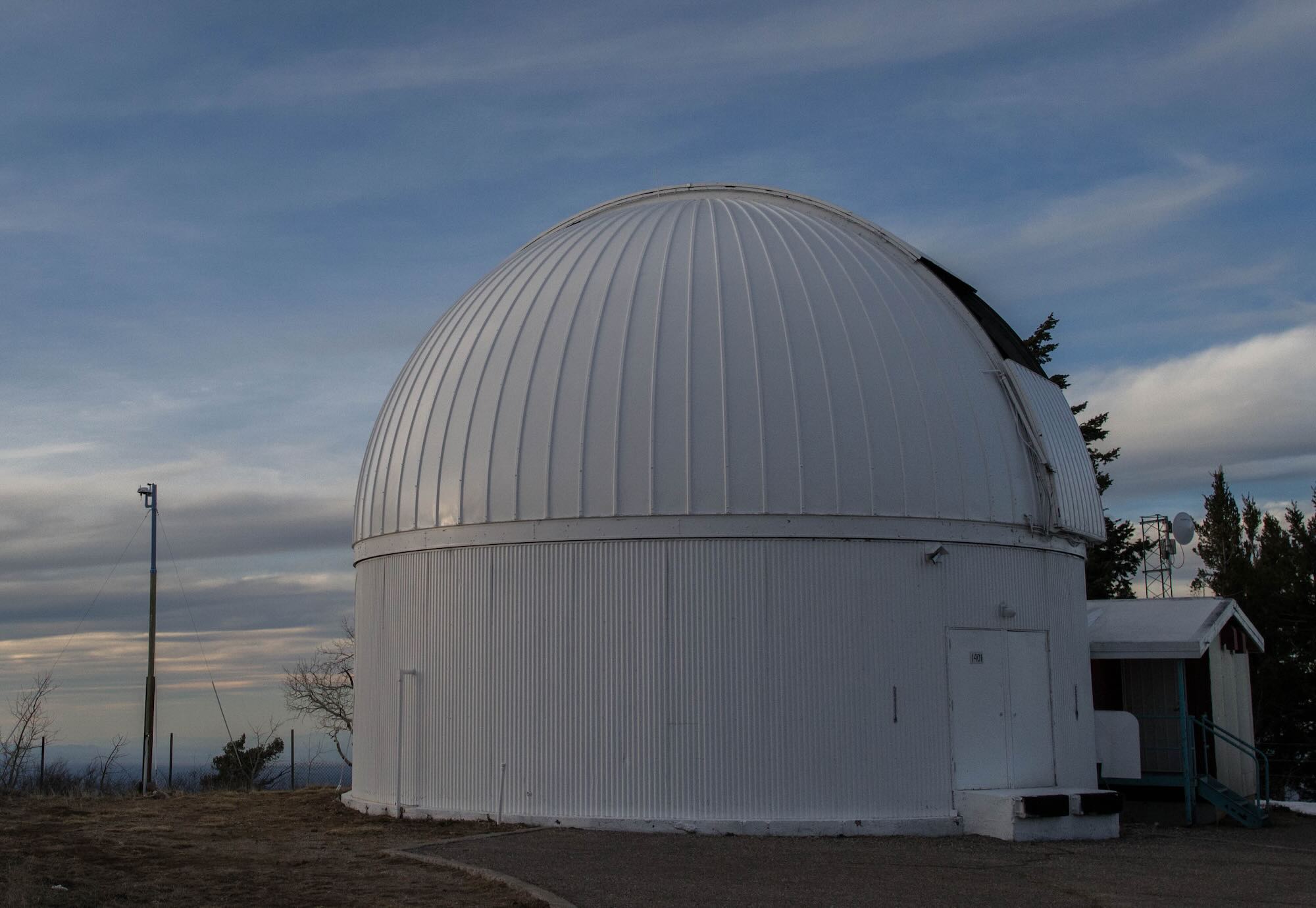
On May 10th, the Mount Lemmon Survey Observatory , located near Tucson, Arizona, detected a magnitude 21 object (very faint). This 1.6-meter diameter telescope, equipped with a 10,560 x 10,560 pixel camera, automatically scans the sky every night, as it is one of three Catalina Sky Survey facilities designed to monitor and locate near-Earth asteroids (whose orbits approach Earth’s). Other observatory networks also act as lookouts for what is known as planetary protection . Thanks to global coordination, this new asteroid, cataloged as 2026 JH2, was studied for two days to determine its trajectory and rule out any risk of collision.
JH2 made its closest approach to Earth on May 18, 2026 at 21:58 Universal Time at a distance of 85215 km according to calculations made.

The Mount Lemmon Survey Observatory in Arizona, which detected asteroid JH2, is part of the Catalina Sky Survey, one of the sky monitoring networks.
© Daniel Oberhaus – CC BY-SA 4.0

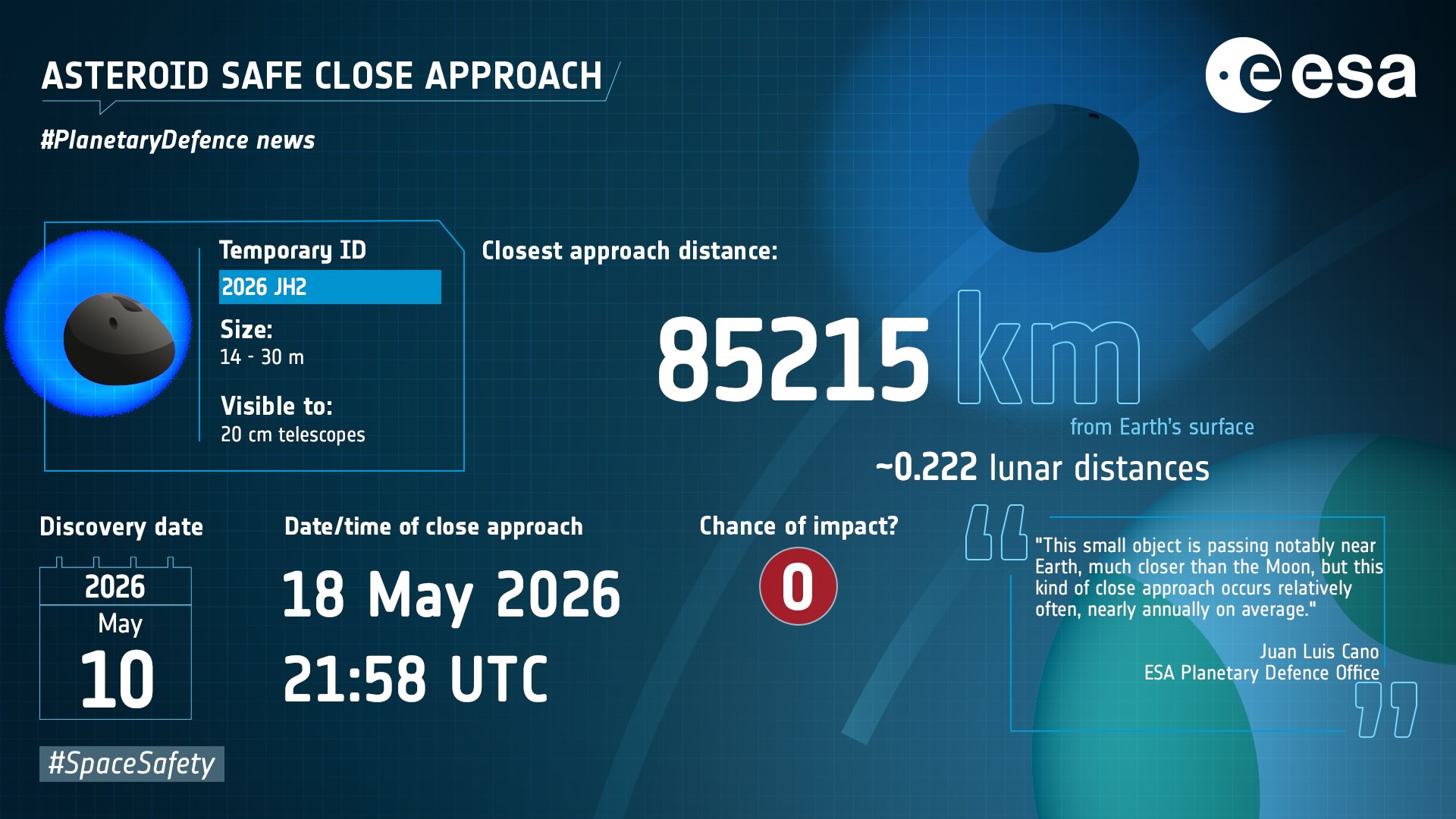
Infographic from the European Space Agency (ESA) explaining that asteroid JH2 passed safely within 85,215 km of Earth on May 18, 10 days after its detection.
© ESA

APPROXIMATELY

ONCE A YEAR

The size of JH2 has been estimated to be between 14 and 30 meters. Had this object entered our atmosphere, the consequences would have been similar to those of the Chelyabinsk meteor (Russia) in 2013, where the shockwave caused damage to buildings and injured a thousand people.
Regarding JH2, Juan Luis Cano of the Planetary Defence Office of the European Space Agency (ESA) points out that the asteroid passed “much closer than the Moon” (0.22 times the Earth-Moon distance) and estimates that “this type of close approach occurs relatively often, nearly annually on average . “

WATCHING THE SKY TO PROTECT THE EARTH

This highlights the importance of the logic behind sky monitoring, which consists of being able, if necessary, to limit the consequences of a potential impact by alerting the relevant authorities and populations. Larger asteroids, capable of causing regional or even more widespread disasters, will logically be detected much earlier (being larger, they are also brighter). Planetary protection would then shift to a different, longer-term approach (over several years or even decades) where the goal would be to deflect the asteroid from its trajectory by impacting it with a probe.

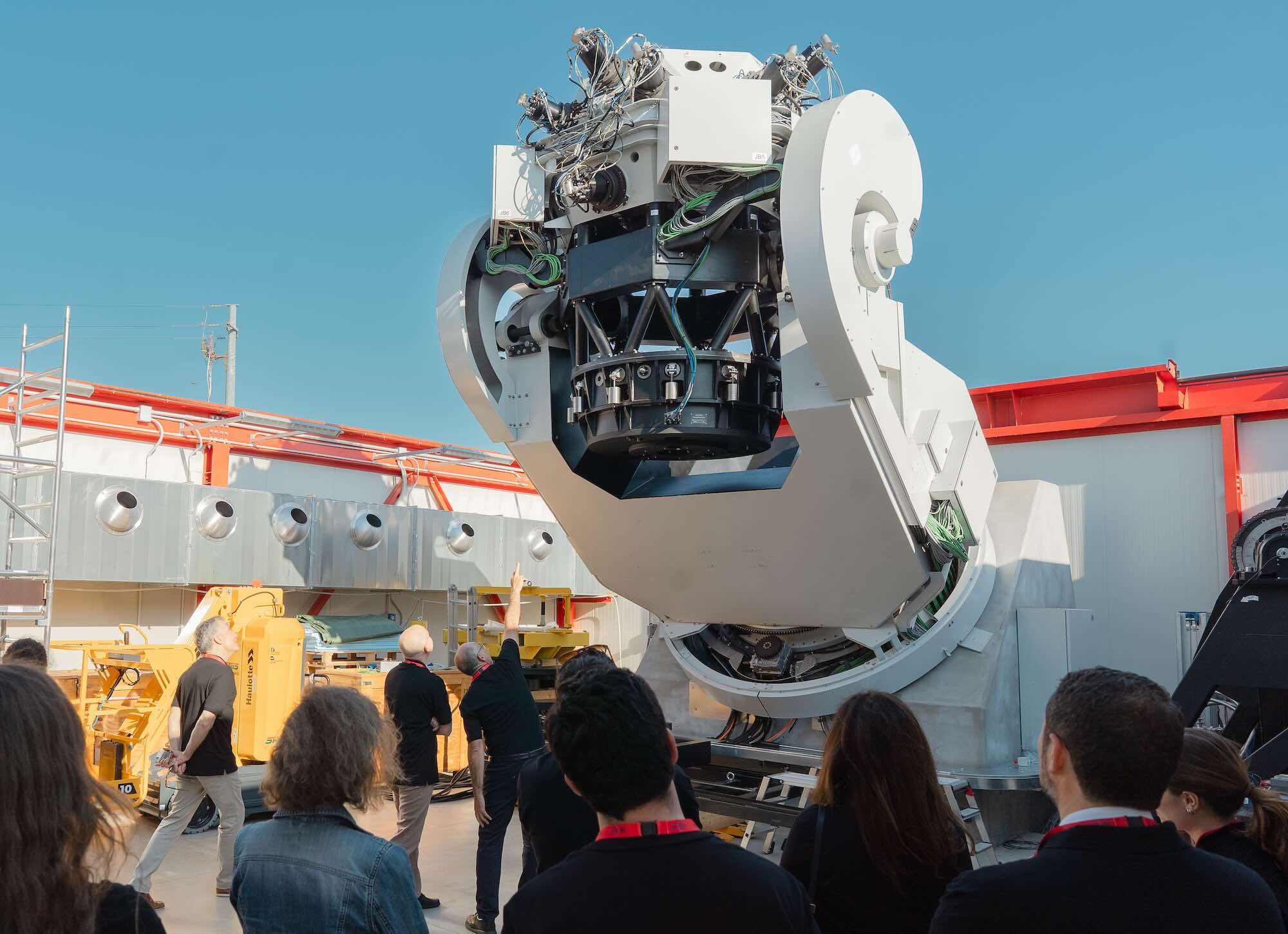
The ESA’s Flyeye telescope during testing by the Italian Space Agency in 2025. This instrument was designed to spot objects that could pose a danger to our planet.
© ESA / Pietro Moliterni

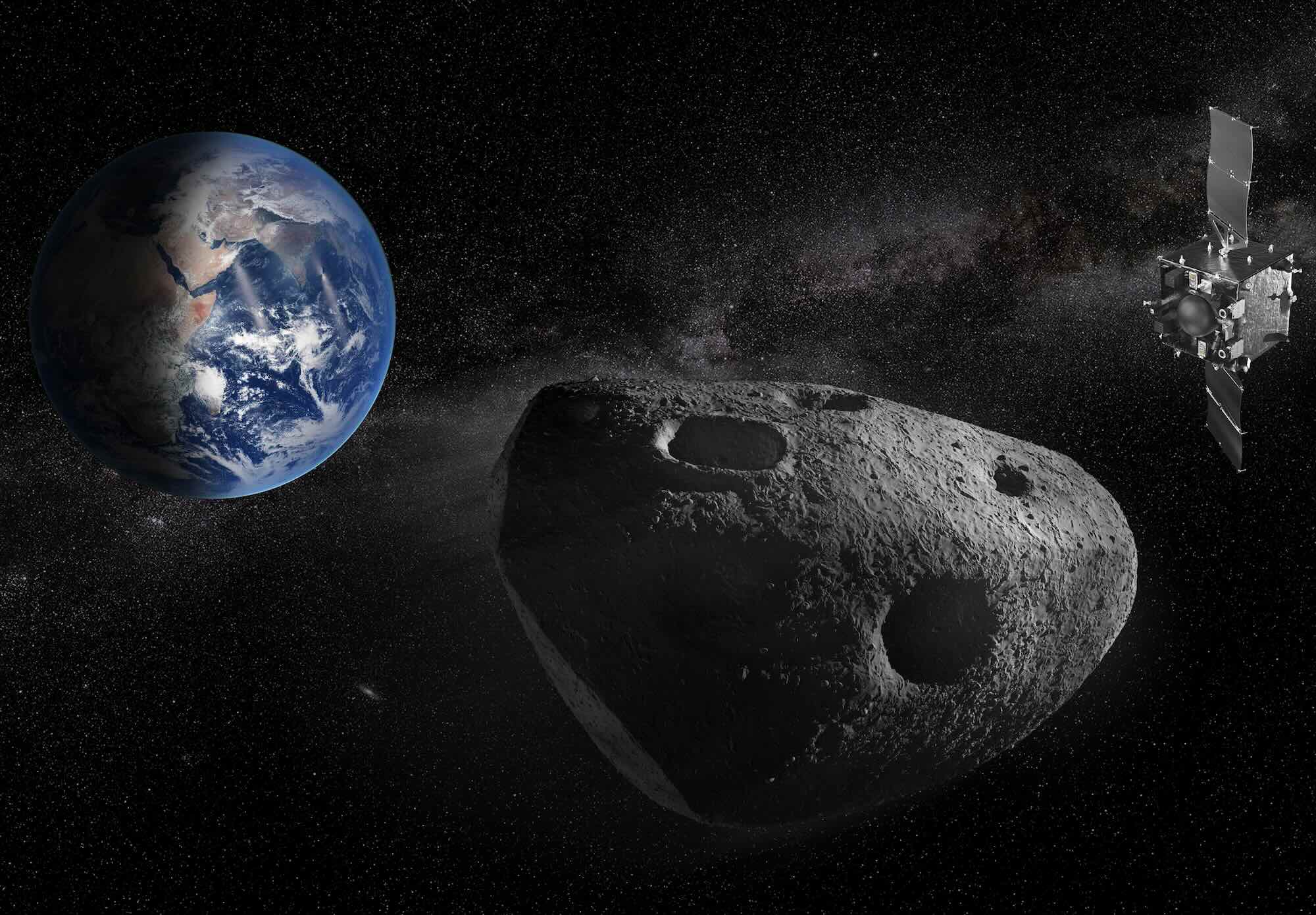
ESA illustration of the Ramses mission, which involves sending a probe to study the asteroid Apophis when it passes within 31,600 km of Earth in April 2029.
© ESA

DART, HERA AND RAMSES

PROBES TO LEARN HOW TO DEFEND THE EARTH

NASA’s DART mission validated the concept in 2022 by colliding with Dimophorphos, a small moon of the asteroid Didymos. The ESA’s Hera spacecraft is scheduled to join this duo in December 2026 to collect additional data. Two years later, in 2028, the Ramses spacecraft , a joint project between the ESA and Japan Aerospace Exploration Agency (JAXA), will launch to closely study the asteroid Apophis when it passes within just 31,600 km of Earth on April 13, 2029. This will be another opportunity to learn more and protect Earth.

Related articles