• Astronomy

The sky of March 2026

Published on 23 February 2026

For March 2026, the Moon has a rendezvous with the planets Venus and Jupiter, as well as with the stars Antares and Regulus.

The sky of March 2026

Before the end of March, the day will have finally caught up with the night. Indeed, the equinox (spring equinox for the Northern Hemisphere) will take place on March 20, 2026 , marking equal length between day and night. From that date until the solstice on June 21, the night sky will be gradually eroded by the sun’s journey.
March is also the month for adjusting our clocks with the switch to summer time . On the night of Saturday, March 28, to Sunday, March 29, at 2:00 a.m., it will officially be 3:00 a.m. (so we need to move our clocks forward one hour; smartphones usually do this automatically).

This is an opportunity to remind you that the times given in this section are in legal time of metropolitan France (the time on your watch), unless otherwise indicated.

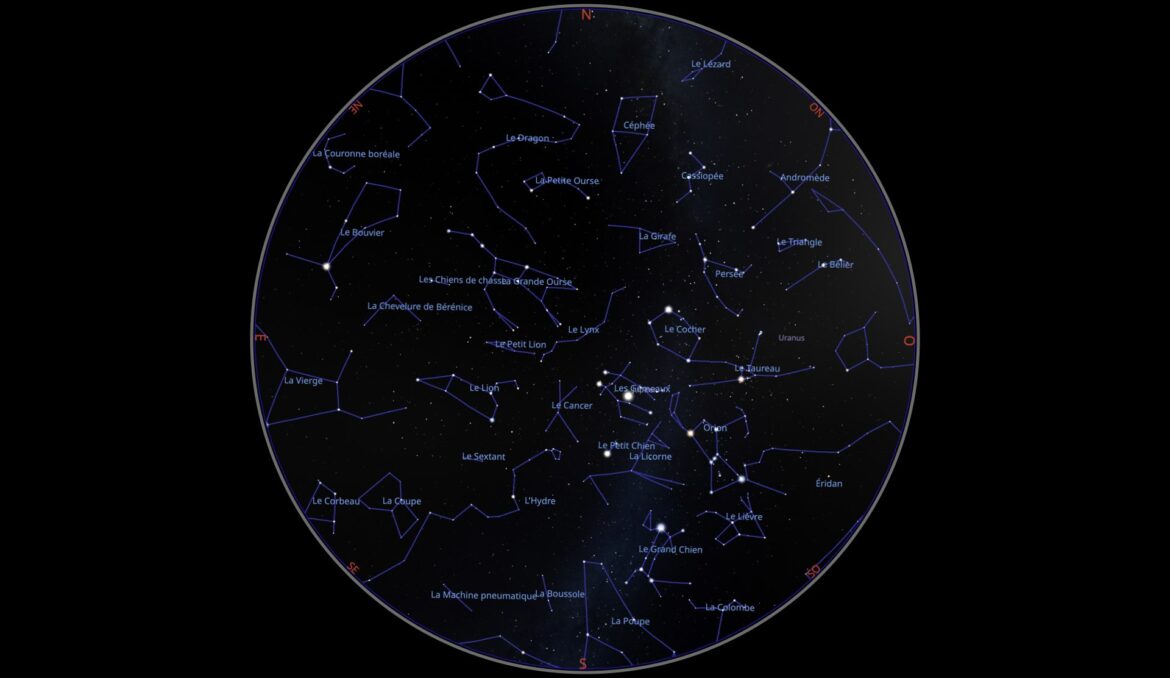
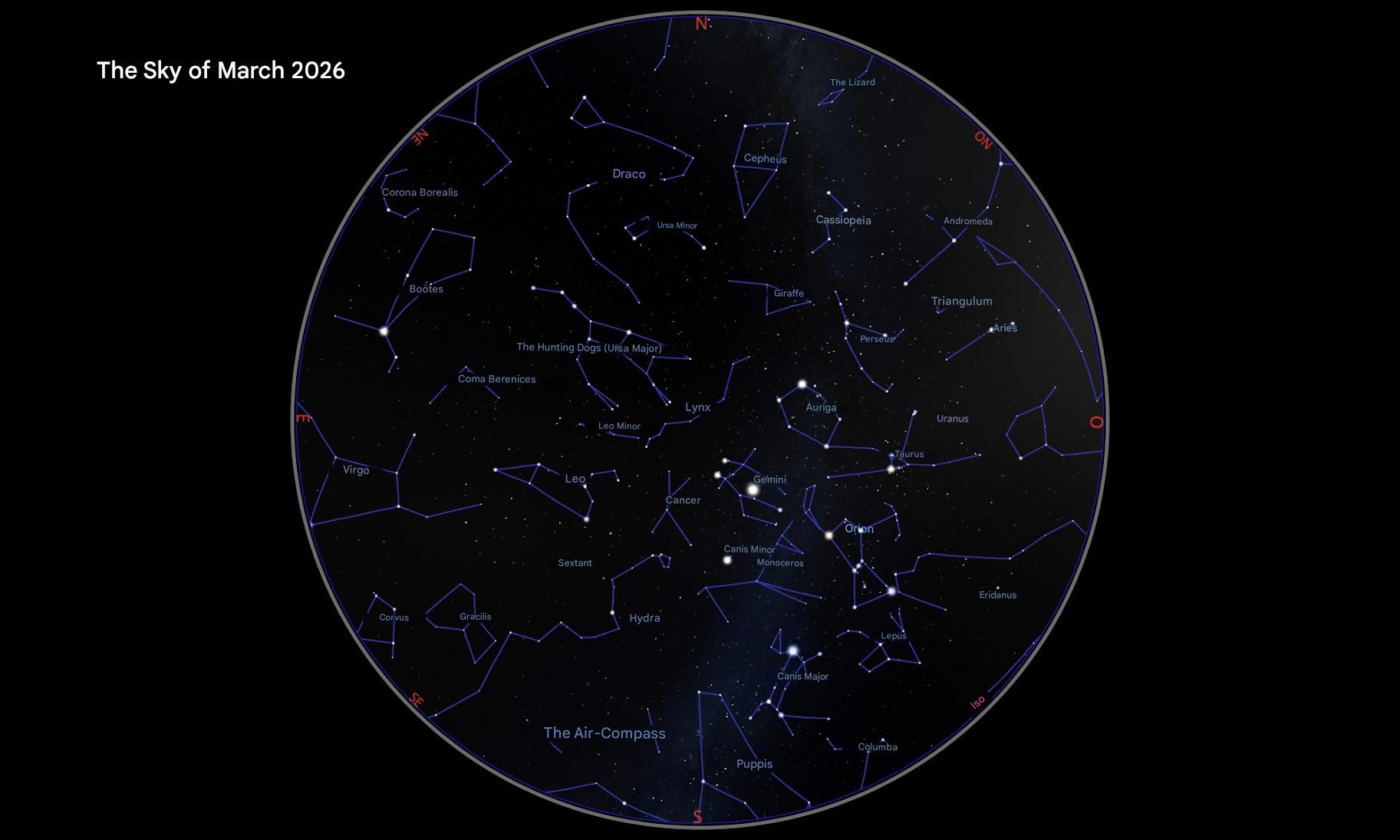
This map shows the sky for Toulouse on March 15, 2026, at 9:30 PM (local time, i.e., your watch time).
It is largely valid for the month of March across all of metropolitan France, except for the position of the Moon (which is not yet visible at that time).
© Cité de l’espace/Stellarium

A HIDDEN LUNAR ECLIPSE

WE WON’T SEE HER IN EUROPE.

On March 3rd, the Moon will pass into the Earth’s shadow . This is the first lunar eclipse of 2026.

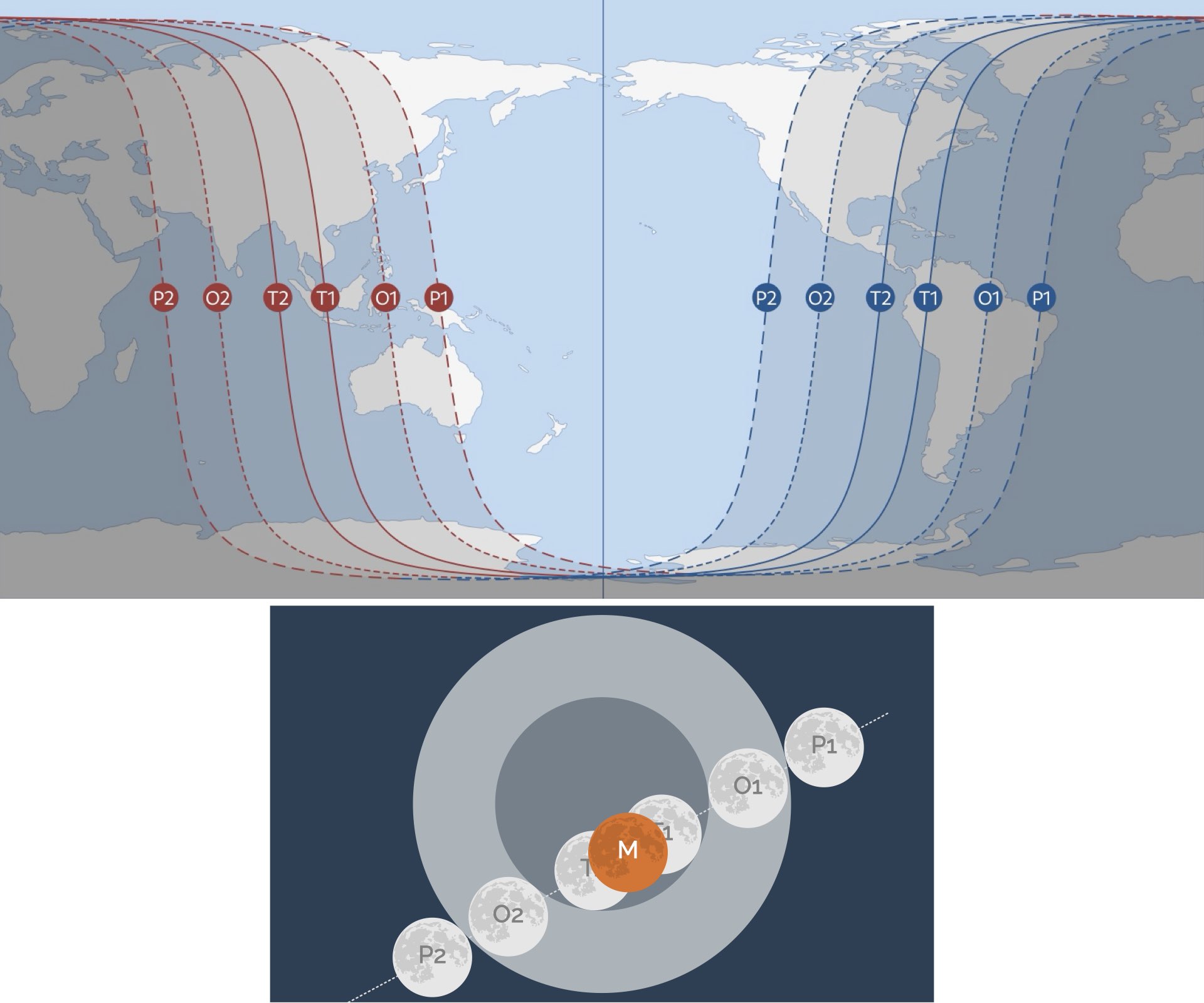
Our natural satellite begins entering Earth’s shadow at 10:50 AM and will be completely out of it by 2:17 PM. However, the Moon will not be visible in France or even in Europe . This event is therefore not observable in this part of the world.


Metropolitan France, however, will be able to witness a large part of the lunar eclipse on August 28th.

The Paris Observatory page

Map of the visibility of the March 3rd lunar eclipse by the Paris Observatory. The visibility of the phenomenon is centered over the Pacific Ocean. Metropolitan France, Europe, and Africa are outside the visibility zone.
The lines define the visibility limits for the following stages: Penumbra (P1), Umbra (O1), Beginning of totality (T1), End of totality (T2), Umbra (O2), and Penumbra (P2).

© Paris Observatory

VENUS AND SATURN

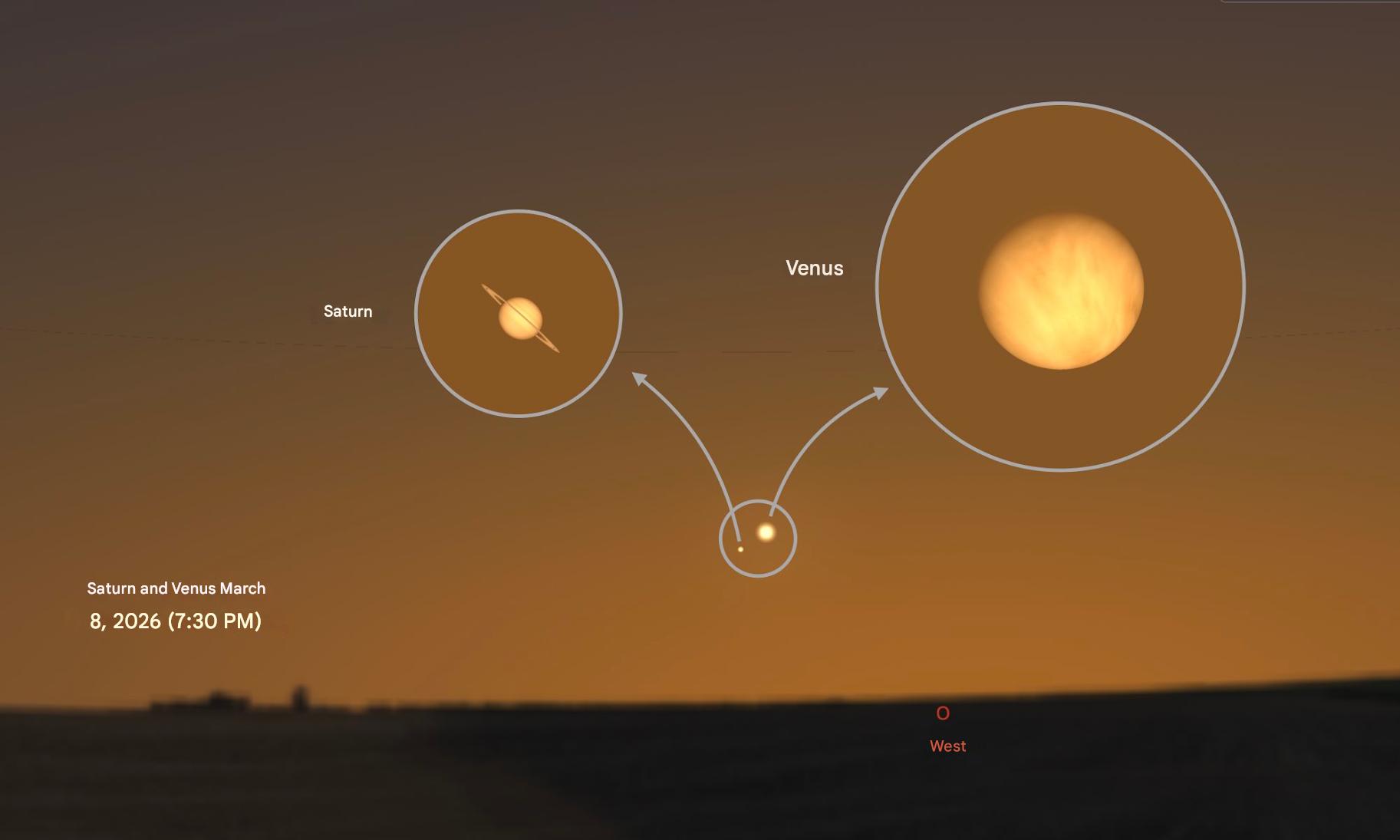
On March 8, Venus and Saturn will be close to each other at the edge of the western horizon .

Please note: wait until the sun has completely set to protect your eyes . That’s why we suggest 7:30 PM for Toulouse, which is just over 30 minutes after sunset (the time varies depending on your location).
This observation is also a bit of a challenge . First, because even though Venus will be shining brightly (magnitude -2.7), it will be only 5° above the horizon. A completely unobstructed view to the west, ideally from a high vantage point, is therefore essential . Saturn will be to the left and slightly lower, about 1° above the horizon, or two lunar diameters. With a magnitude of 2.2, the ringed giant won’t be easy to spot, so don’t be surprised if you don’t see it. A pair of binoculars can also help, which is why it’s crucial to wait until after complete sunset.
This apparent closeness is, of course, a perspective illusion. On March 3rd, Venus will be 245 million kilometers away from us, while Saturn will be 1.56 billion kilometers away from Earth!

Venus and Saturn will be low on the western horizon on March 8, approximately 30 minutes after sunset (for Toulouse). Observation will be difficult.
©Cité de l’espace/Stellarium

THE MOON AND ANTARES

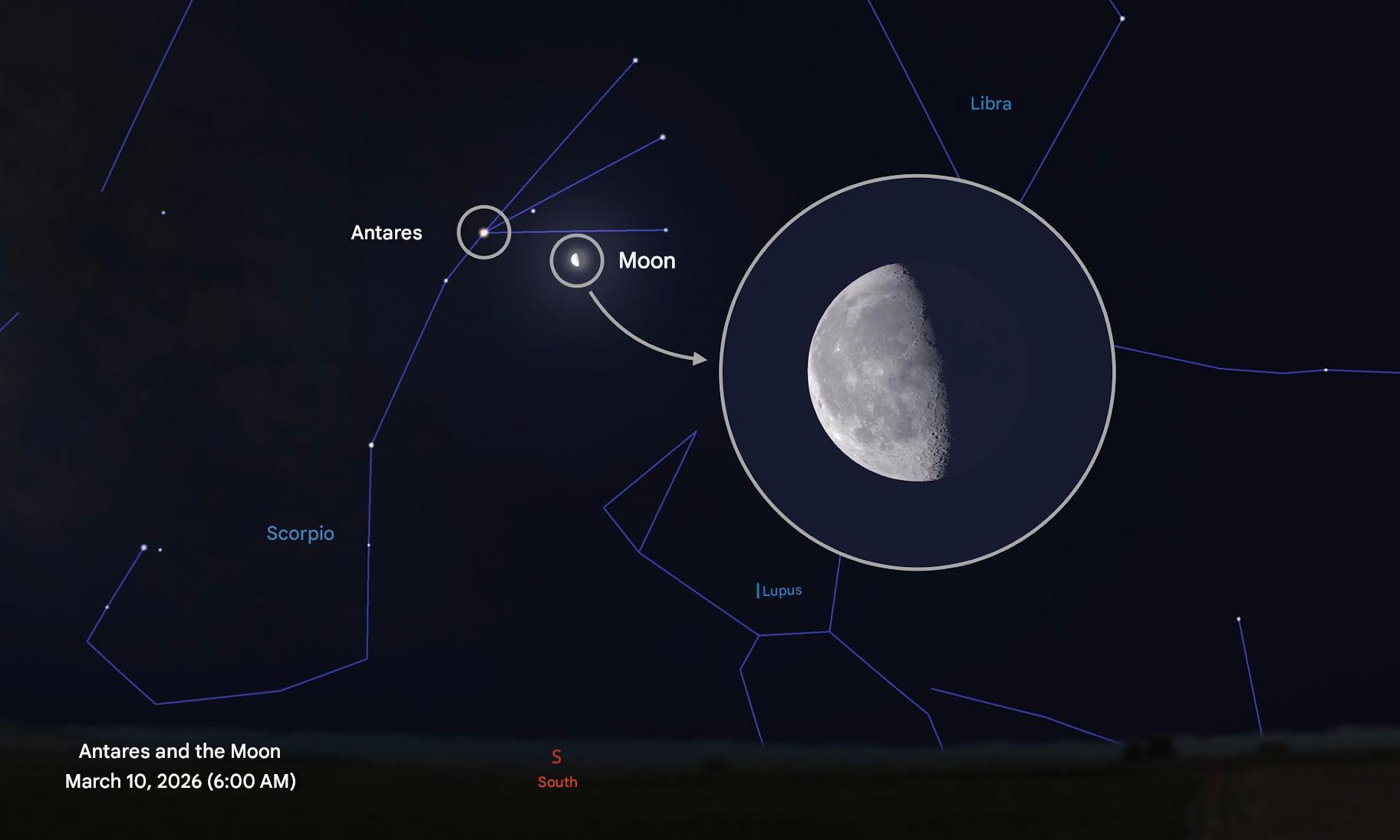
On the morning of March 10, the Moon will visit a patch of sky not far from Antares . Look south a little over an hour before sunrise to take advantage of the still-dark sky. A waning Moon, 61% illuminated, will be 18° above the horizon. To its left, the star Antares will stand out in this region with its brightness (magnitude 1.2) and its characteristic red color.
While our natural satellite will be barely more than a light-second away, the light from Antares will have taken 550 years to reach us . This star is a red supergiant that would encompass much of Mars’ orbit if it were in the position of our Sun.

Antares and the Moon dominate the southern sky on the morning of March 10, a little over an hour before sunrise.

©Cité de l’espace/Stellarium

VENUS AND A CRESCENT MOON

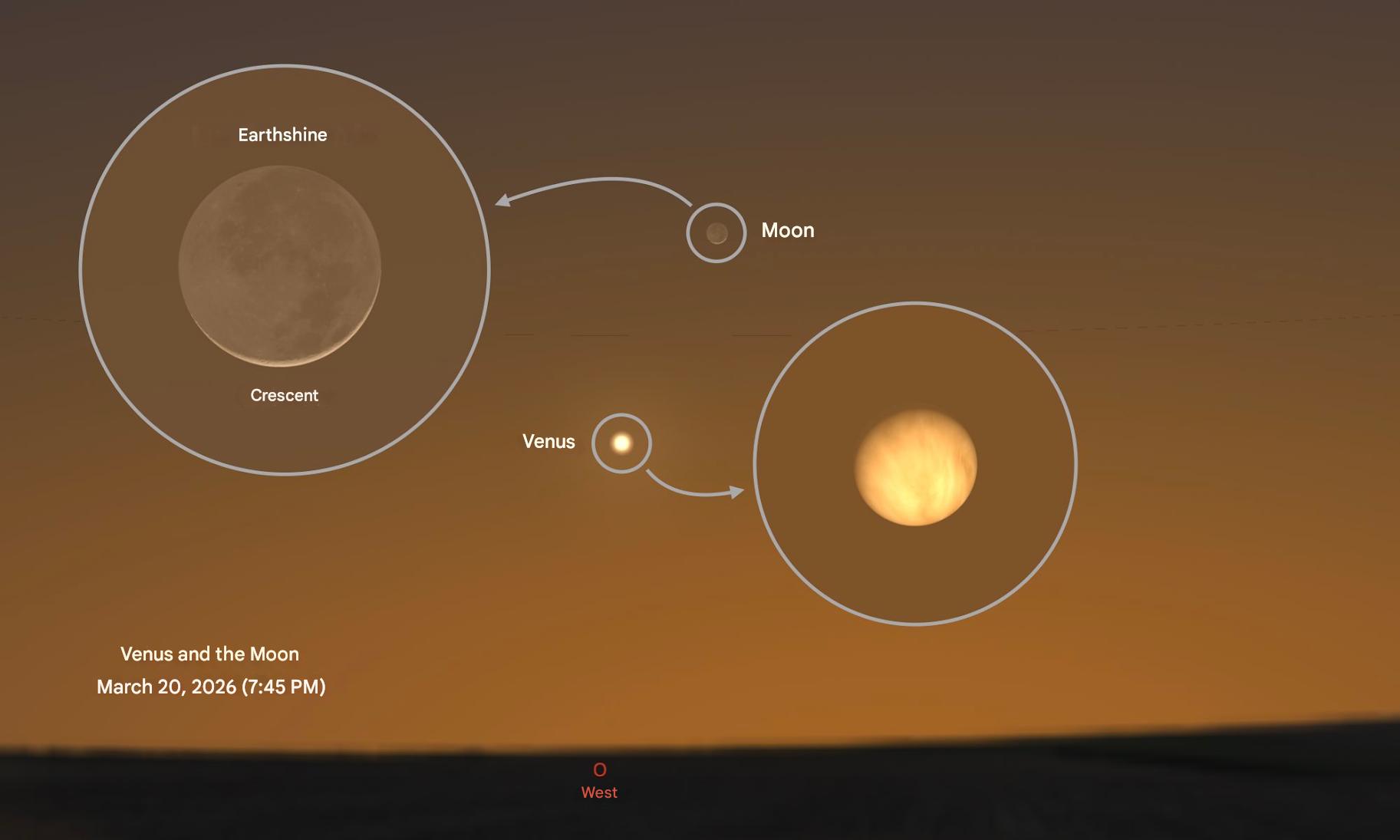
On March 20th, after sunset, Venus will be accompanied by a thin crescent Moon . As with March 8th, this observation isn’t necessarily easy. First, wait until the Sun has set for more than 30 minutes to protect your eyes and until the sky begins to darken slightly. In Toulouse, the Sun will set at 7:06 PM. This time varies depending on your location.
Above the West, at an altitude of only 8°, Venus will be easily distinguishable by its brightness (magnitude -3). However, a perfectly clear horizon is essential (choose a high vantage point, for example). Above and slightly to the right of Venus, look for a very thin crescent Moon (3.7%) at an altitude of 13°. Also, notice the earthshine, which will become increasingly evident as the sky darkens. As a reminder, Earthshine is the part of the Moon illuminated by sunlight that has been reflected by the Earth. The crescent, on the other hand, is directly illuminated by our star.

Venus and a thin crescent moon in the west on March 20, more than 30 minutes after sunset.
©Cité de l’espace/Stellarium

JUPITER AND THE MOON

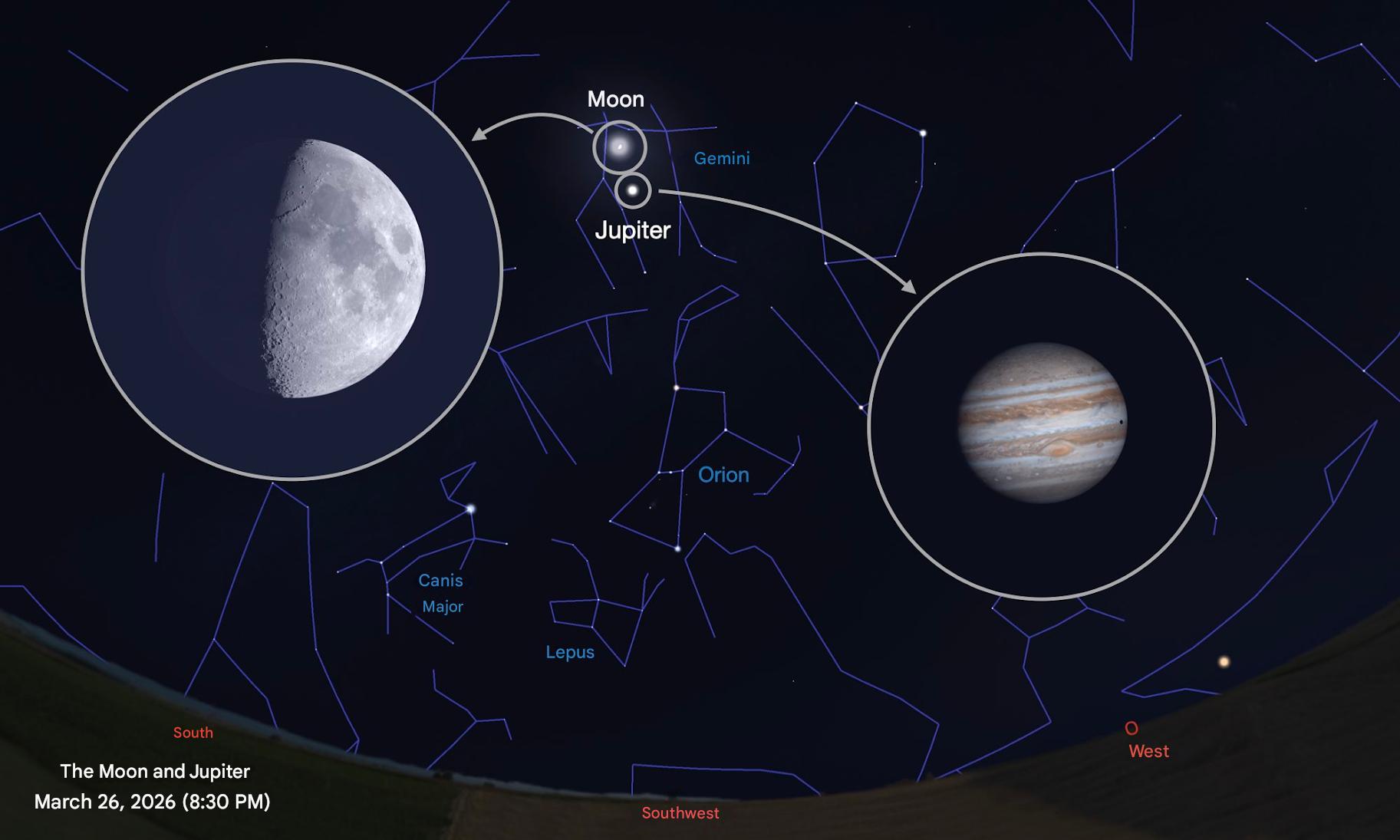
On March 26, the Moon and Jupiter will be prominently displayed in the constellation Gemini , high in the southwestern sky. This time, there are no difficulties to report, apart from the weather, which could spoil the view with clouds.
Around 8:30 p.m., look to the southwest where a waxing Moon (61% illuminated) will be visible at an altitude of 71°. Just below it, at 67° altitude, Jupiter, with a magnitude of -2, will be impossible to miss .
If you have binoculars or a telescope, the conditions will be excellent for viewing these two celestial bodies high in the sky.

The Moon and Jupiter will dominate the southwestern sky on March 26.
©Cité de l’espace/Stellarium

THE MOON AND REGULUS

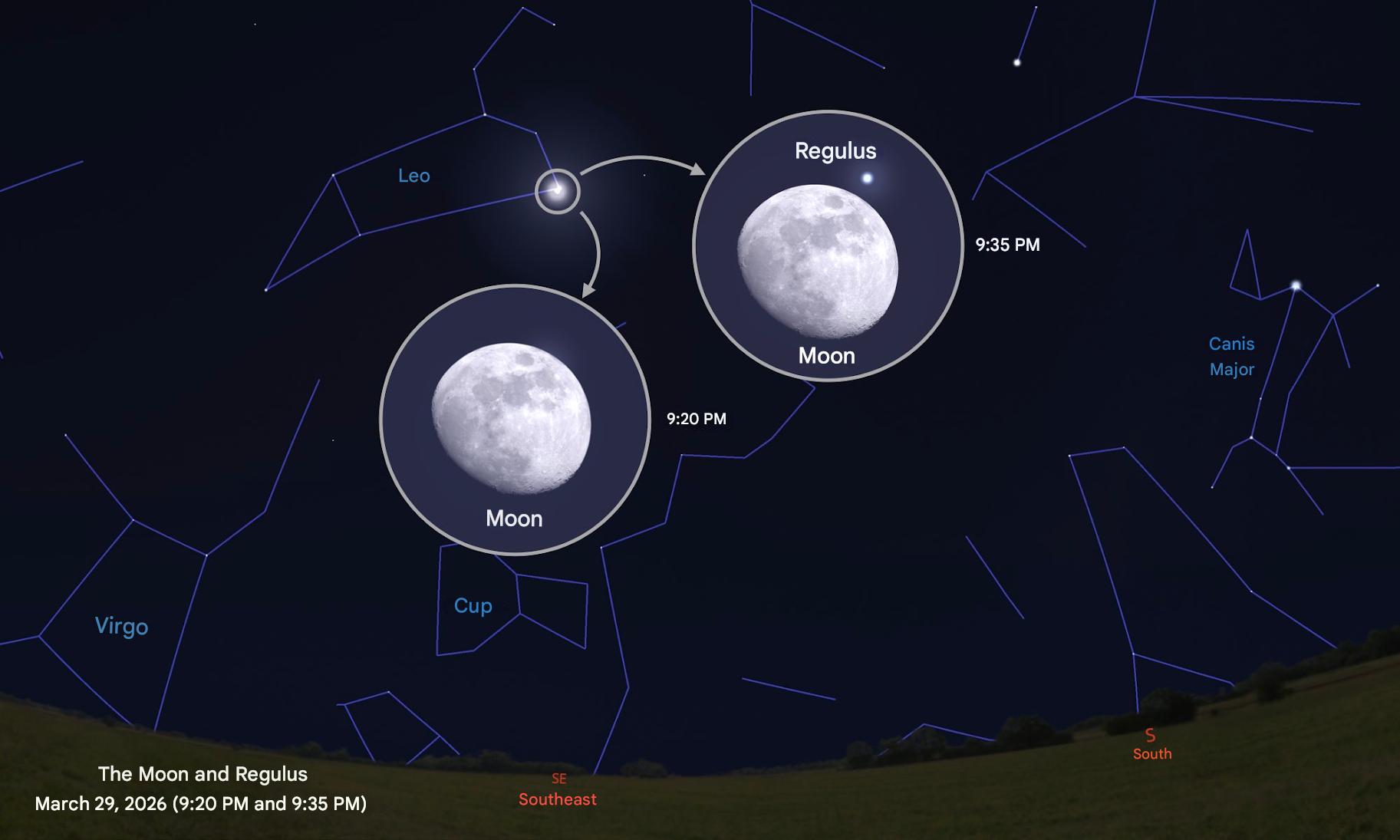
On March 29, the Moon will occult the star Regulus . The beginning of the phenomenon, that is, when the Moon passes in front of Regulus, will occur just minutes before sunset (8:17 PM in Toulouse). This is not ideal.
However, the conditions are much better for seeing Regulus “emerge” from the lunar disk . In fact, due to its own motion relative to the stars, it is the Moon that moves away from the star’s position.
For Toulouse, Regulus will become visible again shortly after 9:23 PM (the exact time depends on your location due to parallax; Regulus is much farther from us than the Moon). Be aware that the strong brightness of our natural satellite may prevent you from spotting Regulus (magnitude 1.5) for a short while, even though it is the brightest star in the constellation Leo. Binoculars, a telescope, or a spotting scope will allow you to spot Regulus more quickly, but the star will eventually be visible to the naked eye once the Moon has moved far enough away. Since
the phenomenon is occurring in the southeast at an altitude of 47°, viewing conditions are expected to be very favorable.

On March 29, observe the Moon as it reveals Regulus.
©Cité de l’espace/Stellarium

Related articles