• Mars

Has Perseverance found evidence that life developed on Mars?

Published on 19 September 2025

The Perseverance rover has found traces of vivianite and geigite on a Martian rock. On Earth, these elements are generated by life. However, caution is needed: a sample return is necessary to confirm that these molecules are indeed biosignatures.

Has Perseverance found evidence that life developed on Mars?

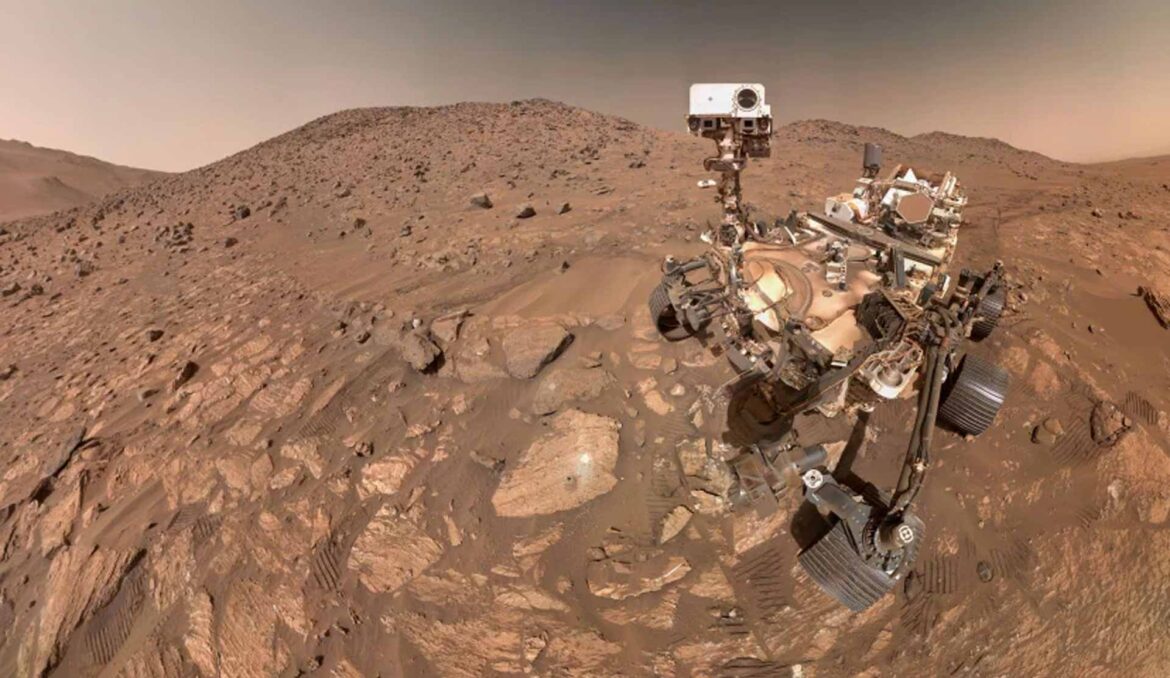
Could this leopard rock be the key to the enigma? In any case, the clues are piling up. In a new study published in the journal Nature , and presented by NASA on September 10, 2025 , researchers detail the analysis of minerals present in this rock . The Mars rover Perseverance crossed paths with this stone, named “Cheyava Falls,” in July 2024. The formations studied could be the byproducts of microbial metabolism. This is a new step forward in the search for signs of past life, but not yet proof . Additional analyses, preferably on Earth, will be necessary for definitive biological confirmation.

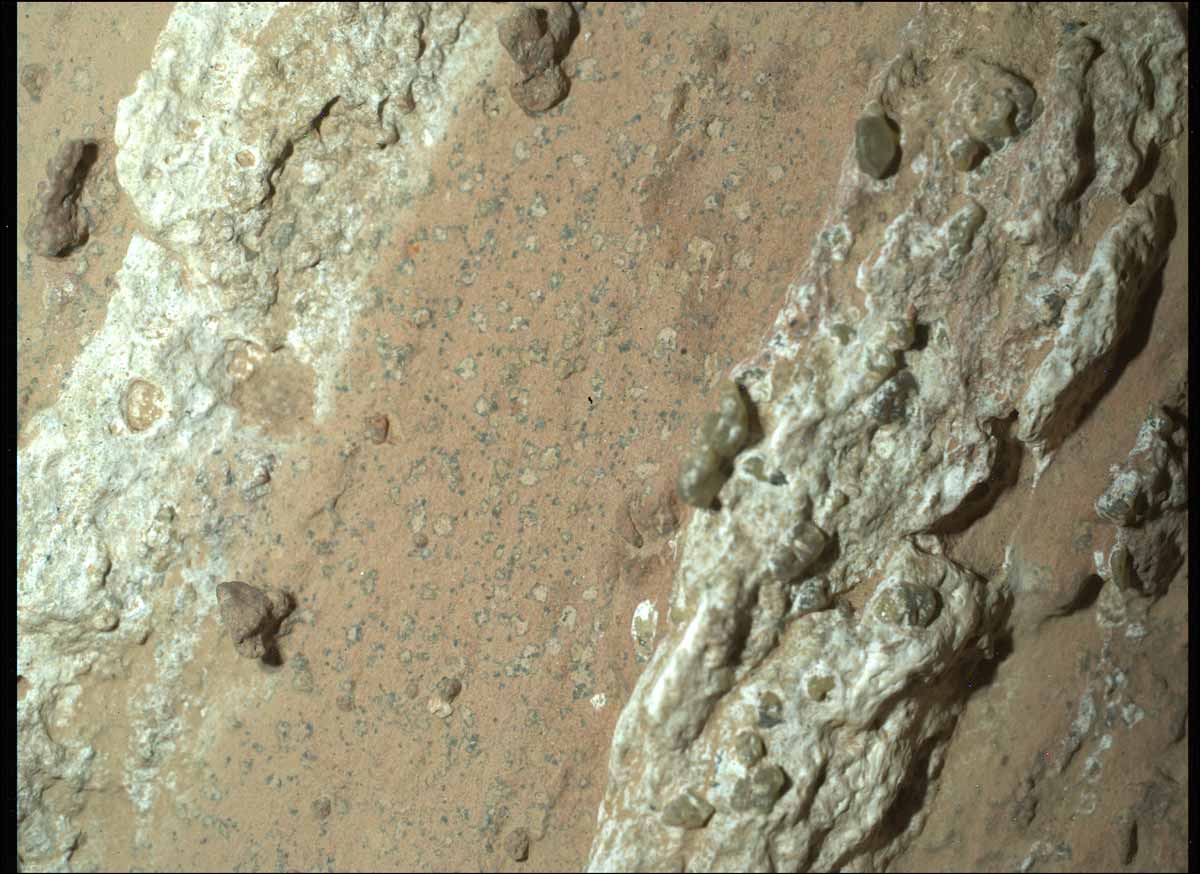
It is this rock, dubbed “Cheyava Falls,” that may contain traces of past life. The inset features “poppy seeds” and “leopard spots” that prompted scientists to further investigate this rock.

© NASA / JPL

An intriguing discovery from the Perseverance rover

The Cheyava Falls rock and its “leopard spots”

During its exploration of Jezero Crater , a vast Martian depression believed to have once housed a lake, the Perseverance rover examined a region on the crater’s western rim. These clayey rocks from the Neretva Vallis valley are found on a formation nicknamed “Bright Angels.” There, scientists’ attention was drawn to a rock about 1 meter by 0.6 meters, dubbed “Cheyava Falls .” This rock had unusual features, described as “poppy seeds” and “leopard spots,” “small whitish spots a few millimeters wide surrounded by black.” The rover’s instruments, including PIXL and SHERLOC , analyzed these features. They revealed the presence of organic carbon, sulfur, oxidized iron, and phosphorus . The “leopard spots” themselves contained minerals rich in iron and phosphorus, identified as vivianite (hydrated iron phosphate), as well as iron sulfide, called greigite . ” When we observe features like these in sediments on Earth, these minerals are often the byproduct of microbial metabolisms that consume organic matter ,” Joel Hurowitz, a planetary scientist at Stony Brook University in New York and lead author of the new study, said at a NASA press conference. ” On Earth, these types of features in rocks are often associated with the fossilized traces of microbes living underground, ” added David Flannery, an astrobiologist and member of the Perseverance science team at Queensland University of Technology in Australia.

Discover Perseverance at the Cité de l’Espace

How does it work? What are its instruments? What can we expect from this mission? The “Rovers Enter the Stage” animation at the Cité de l’Espace allows you to understand this extraordinary mission thanks to the life-size model of NASA’s rover.

A potential biosignature, not proof of life

The “CoLD Scale” to assess trust

While these results are promising, it is crucial to remain measured. The study authors emphasize that further analysis is needed to determine the exact origin of these minerals . ” I want to remind everyone that what we are describing here is a potential biosignature ,” said Lindsay Hayes, NASA’s lead scientist for Mars exploration. ” It is an element, molecule, substance, or characteristic that could have a biological origin but requires more data or further study before reaching a conclusion about the presence or absence of life .” On Earth, vivianite is frequently found in sediments, peat bogs, and around decaying organic matter , while some forms of microbial life can produce greigite. However, these minerals can also be generated by abiotic processes , that is, without the intervention of life , particularly under high temperatures or very acidic conditions. 

Capture-d'écran-2025-09-11-114932

Lindsay Hayes, NASA’s lead scientist for Mars Exploration; Amit Kshatriya, NASA’s associate administrator; Nicky Fox, NASA’s associate administrator and director of science; and Sean Duffy, NASA’s acting administrator. Press conference on September 10, 2025.

There are seven criteria in the Confidence in the Detection of Life (CoLD) Scale. It describes a progression of confidence that a set of observations constitutes proof of life.
© NASA© NASA

However, the rocks of the Bright Angel Formation show no signs of having been subjected to such extreme conditions. The scientific community uses tools like the “CoLD Scale” (Confidence of Life Detection) to assess the level of confidence in the  detection of life .  The current discovery represents only the first step of this seven-point scale . ”  These marks are not life itself  ,” said Nicky Fox, Associate Administrator for NASA’s Science Mission Directorate. ”  But they certainly could have been the result of ancient life, and that would go back billions of years  .”

The imperative of sample return

Challenges of the Mars Sample Return Program

The instruments aboard Perseverance have reached their limits in terms of on-site analysis capacity. “ We’re pretty close to the limits of what the rover can do on the surface in terms of making progress on this particular question ,” says Katie Stack Morgan, Perseverance project scientist at NASA’s Jet Propulsion Laboratory. “ It was designed that way. The Perseverance rover’s payload was selected with a Martian sample return effort in mind; the idea was that our payload would take us all the way to the potential biosignature designation and the rest of the story would be told by instruments here on Earth .” The rover has already collected a sample , the 25th of its mission, of this rock, named “Sapphire Canyon,” on July 21, 2024. To get decisive confirmation of the presence of ancient life on Mars, these samples would need to be brought back to Earth to be studied in laboratories with more sophisticated instruments.

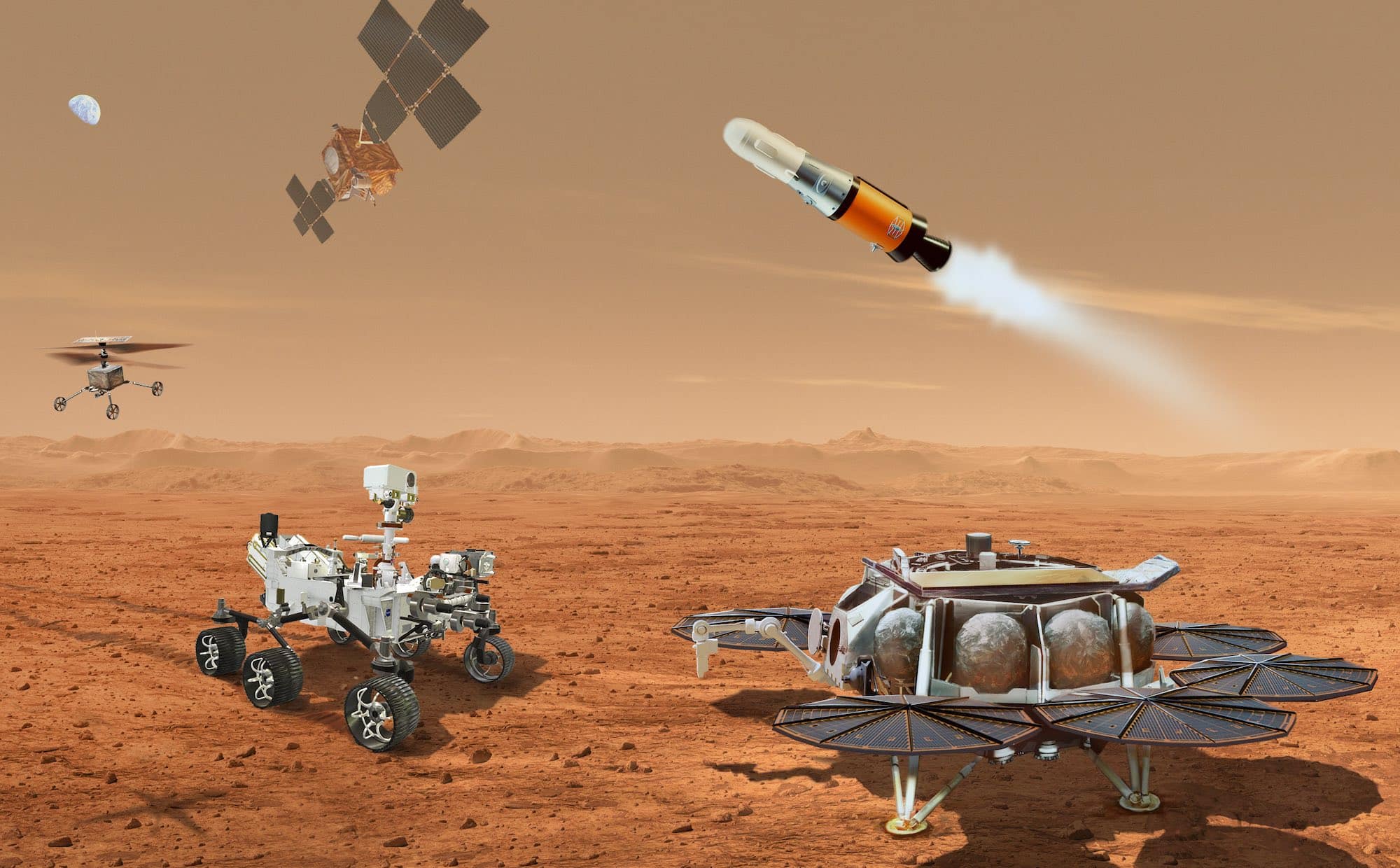
The Mars Sample Return mission planned to return samples collected by the rover from the launch of Perseverance.

© NASA / ESA

 Unfortunately, the Mars Sample Return program, a collaboration between NASA and the European Space Agency that aims to bring back these samples, is facing  budgetary uncertainties  and changing  priorities . This announcement may also serve to revive interest in sample return.  Sean Duffy , NASA’s acting administrator, reiterated  the agency’s commitment to sample recovery , even if the method could change: ”  We are looking at how to recover this sample. We believe there is a better way to do it, a faster way  .” In December 2024, NASA indicated that it was giving itself a year and a half to  rethink the architecture of the Mars Sample Return mission . The goal is to make it less expensive. A decision could be made by mid-2026 for a return planned between 2035 and 2040. On this mission,  as for the Moon , China is also a serious challenger. The Chinese Space Agency plans to launch a mission in 2028 and return around 2031.

Related articles