• Exploration

Voyager 1 at one light-day from Earth

Published on 15 October 2026

Launched in 1977, NASA's Voyager 1 probe is still operational. Continually moving further away from us, on November 18th it will be one light-day away from Earth, or 25.9 billion kilometers.

Voyager 1 at one light-day from Earth

In the 1970s, NASA’s Jet Propulsion Laboratory (JPL) in California launched the Voyager program to send probes to visit the giant planets Jupiter, Saturn, Uranus, and Neptune. This ambitious journey was made possible by the planets’ remarkable positions in their respective orbits, which allowed for a trajectory that minimized the need for propulsion (otherwise, the probes would have had to carry far too much fuel).

A little over 49 years later, the two Voyager 1 and Voyager 2 probes are still working and one of them will soon exceed the symbolic distance of a light-day.

VOYAGER 1 AND 2

TWO TWIN PROBES

Contrary to what the numbers 1 and 2 might suggest, it was Voyager 2 that took off first on August 20, 1977 from Florida, followed by Voyager 1 on September 5 of the same year.

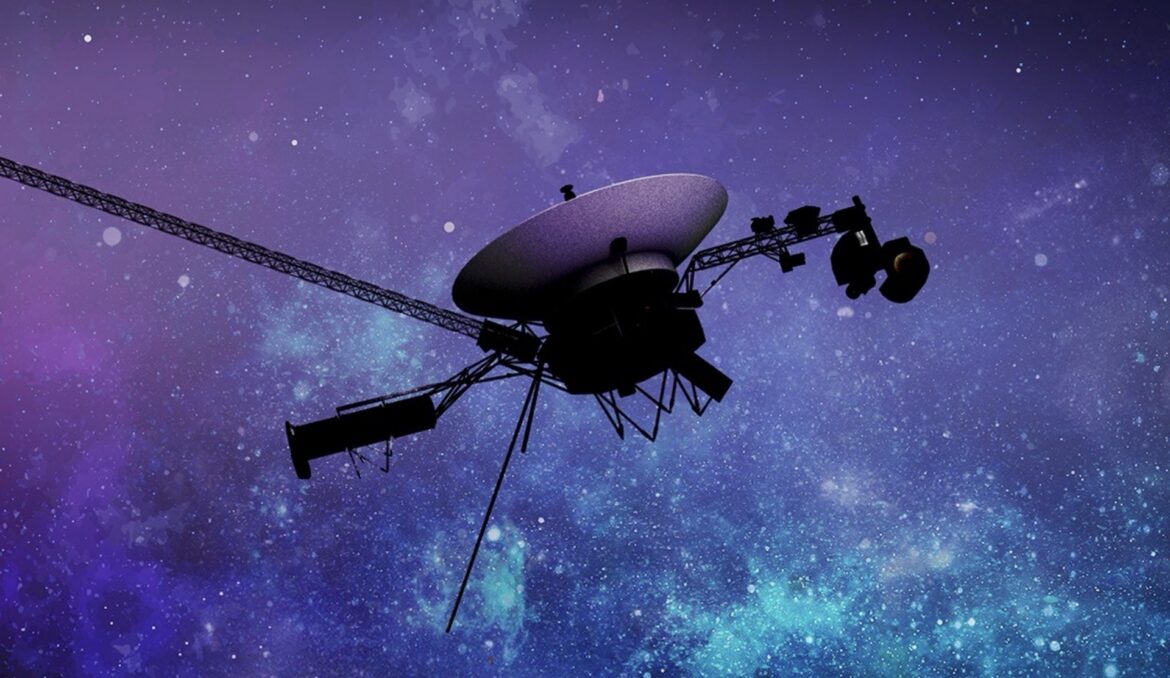
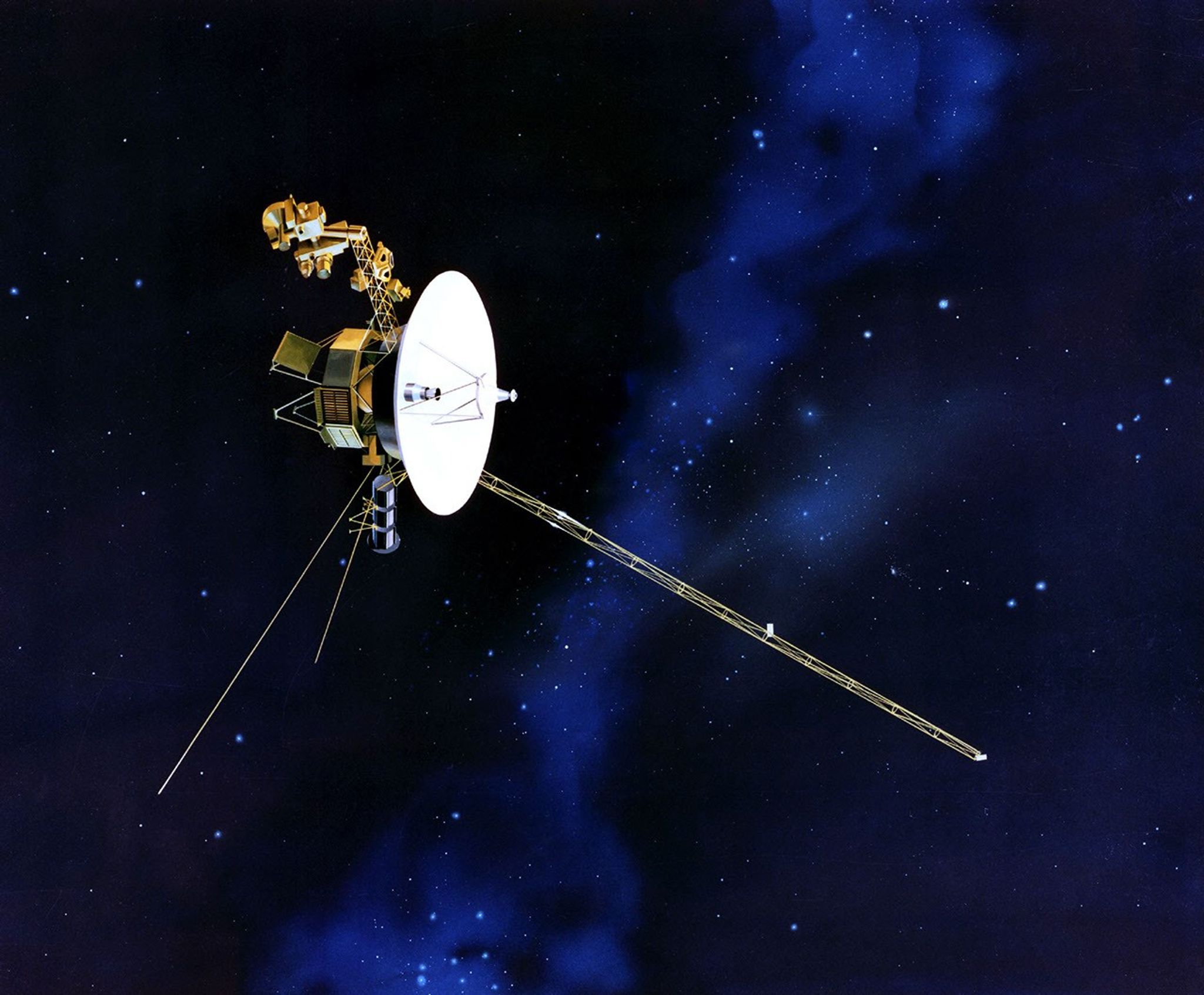
The two twin probes built by JPL are characterized by their large 3.7 m diameter antenna. This size was designed to allow radio communications over the long distances planned for their mission.

Artist’s impression of a Voyager probe. Note the imposing 3.7 m diameter antenna.
© NASA

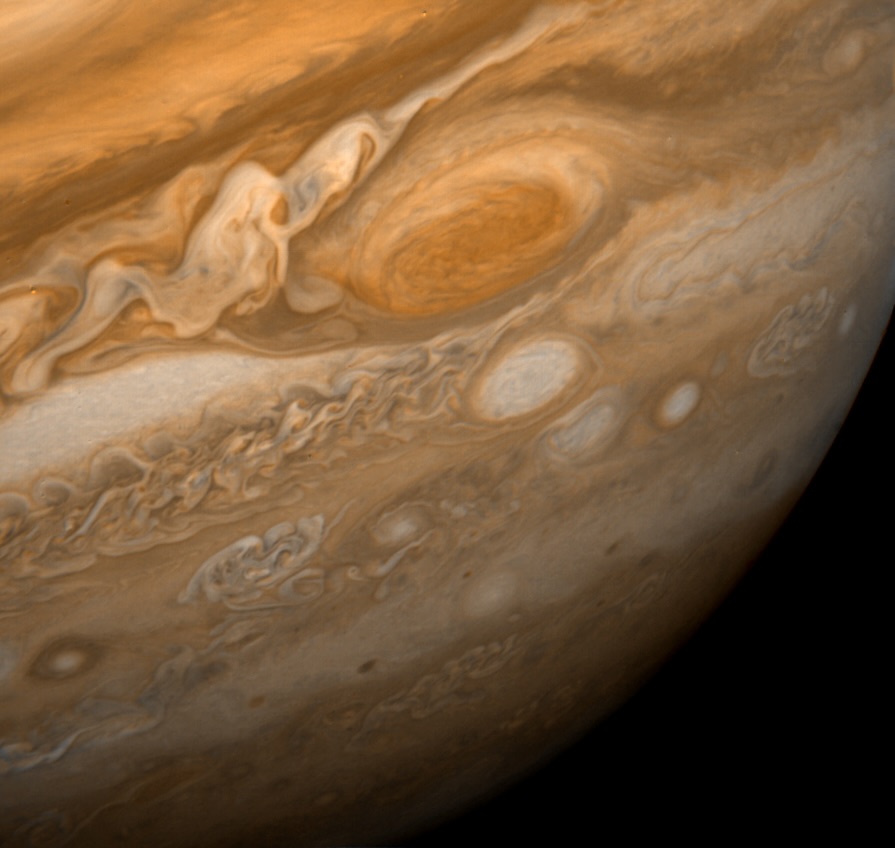
Jupiter’s Great Red Spot photographed by Voyager 1 in 1979.
© NASA/JPL

JUPITER AND SATURN

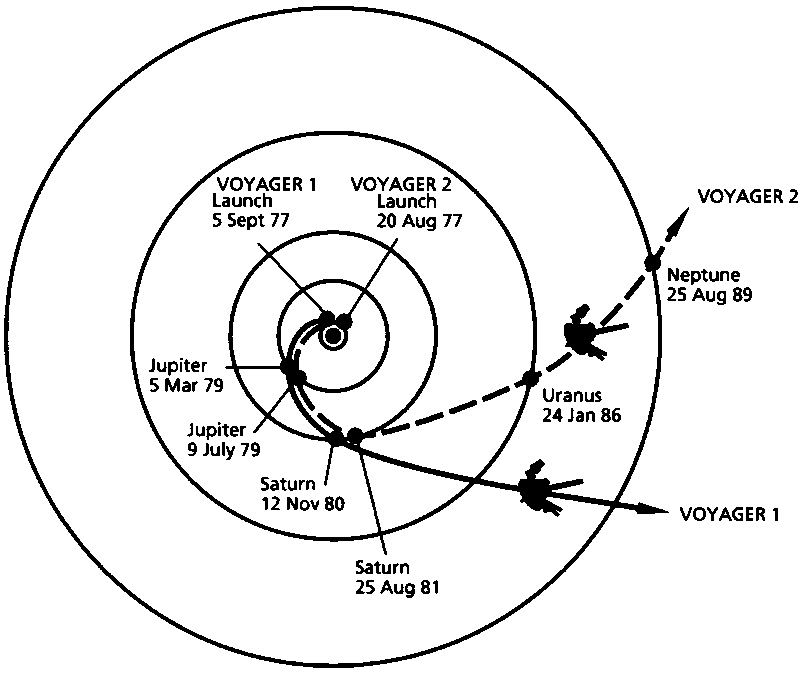
The two probes also shared two initial objectives: to fly by Jupiter and then Saturn. Due to their different trajectories, Voyager 1 was the first to fly by, passing Jupiter in March 1979 and Saturn in November 1980.Voyager 2 followed suit in July 1979 and August 1981, respectively.
Even though Jupiter had been flown by NASA’s Pioneer 10 and 11 (in 1973 and 1974) and Saturn by Pioneer 11 (in 1979), the images and data collected by Voyager 1 and 2 represented a significant leap forward in the study of the two giant planets.

VOYAGER 1 IS HEADING TOWARDS INTERSTELLAR SPACE

The paths of Voyager 1 and 2 diverged with regard to Saturn . Voyager 1’s trajectory was designed to allow it to fly close to Titan , the largest moon of the ringed giant, in order to gather data on its thick atmosphere—a unique feature among the moons of the Solar System. Because of this choice, Voyager 1 followed a route that prevented it from visiting Uranus and Neptune . Voyager 2, on the other hand, brought back images and data of these two planets in January 1986 and August 1989. To this day, Voyager 2 remains the only probe to have flown past them.
Placed on a “faster” route, Voyager 1 hurtled toward the edge of the Solar System and interstellar space . But it would still take several years to reach this point…

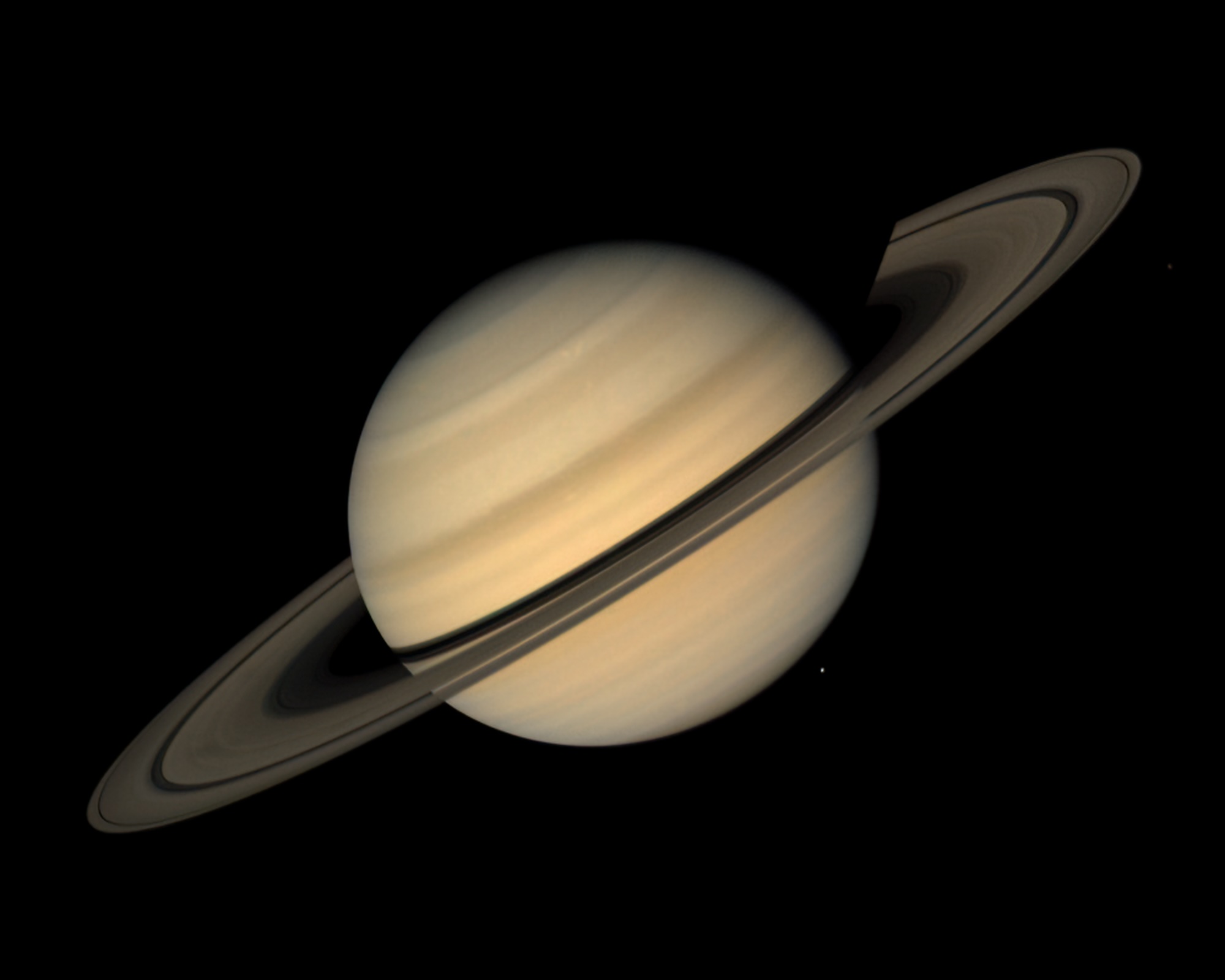
Saturn photographed by Voyager 1 in November 1980.
© NASA/JPL

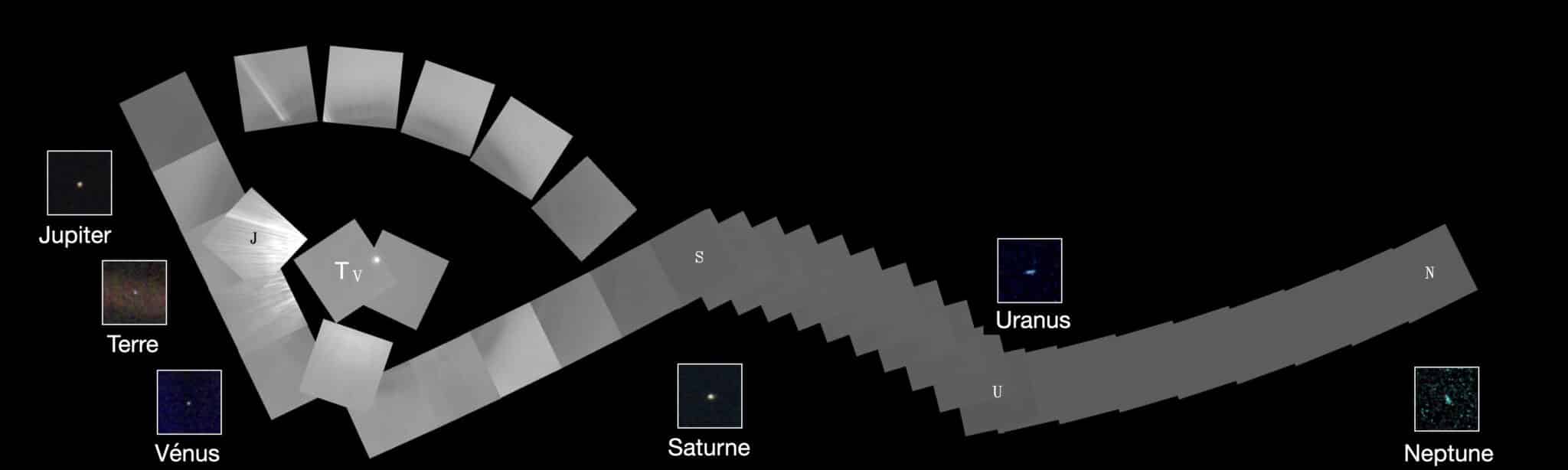
The famous “family portrait” of the Solar System taken by Voyager on February 14, 1990.
© NASA/JPL-Caltech

A FAMILY PORTRAIT

 On February 14, 1990, Voyager 1 took a “family portrait” of the Solar System while six billion kilometers from Earth. American astronomer Carl Sagan wrote his famous essay ” A Pale Blue Dot “ about this . This was the last time the probe’s cameras were used , as NASA had to gradually shut down some scientific instruments to compensate for the anticipated decrease in electrical power from the three radioisotope thermoelectric generators (the heat from plutonium-238 is converted into electrical current by a thermocouple).

VOYAGER 1:
FIRST PROBE INTO INTERSTELLAR SPACE

In September 2013, the American space agency confirmed that Voyager 1 had been traveling through interstellar space since the end of August 2012 , more than 18 billion kilometers from the Sun. While the probe remains primarily subject to the Sun’s gravitational field, even though its speed allows it to escape it, data from Voyager 1’s instruments show that the particles and radiation it receives originate more from the interstellar medium than from our star.

Trajectories of Voyager 1 and 2. NASA image from the time of the 1977 launch.
© NASA

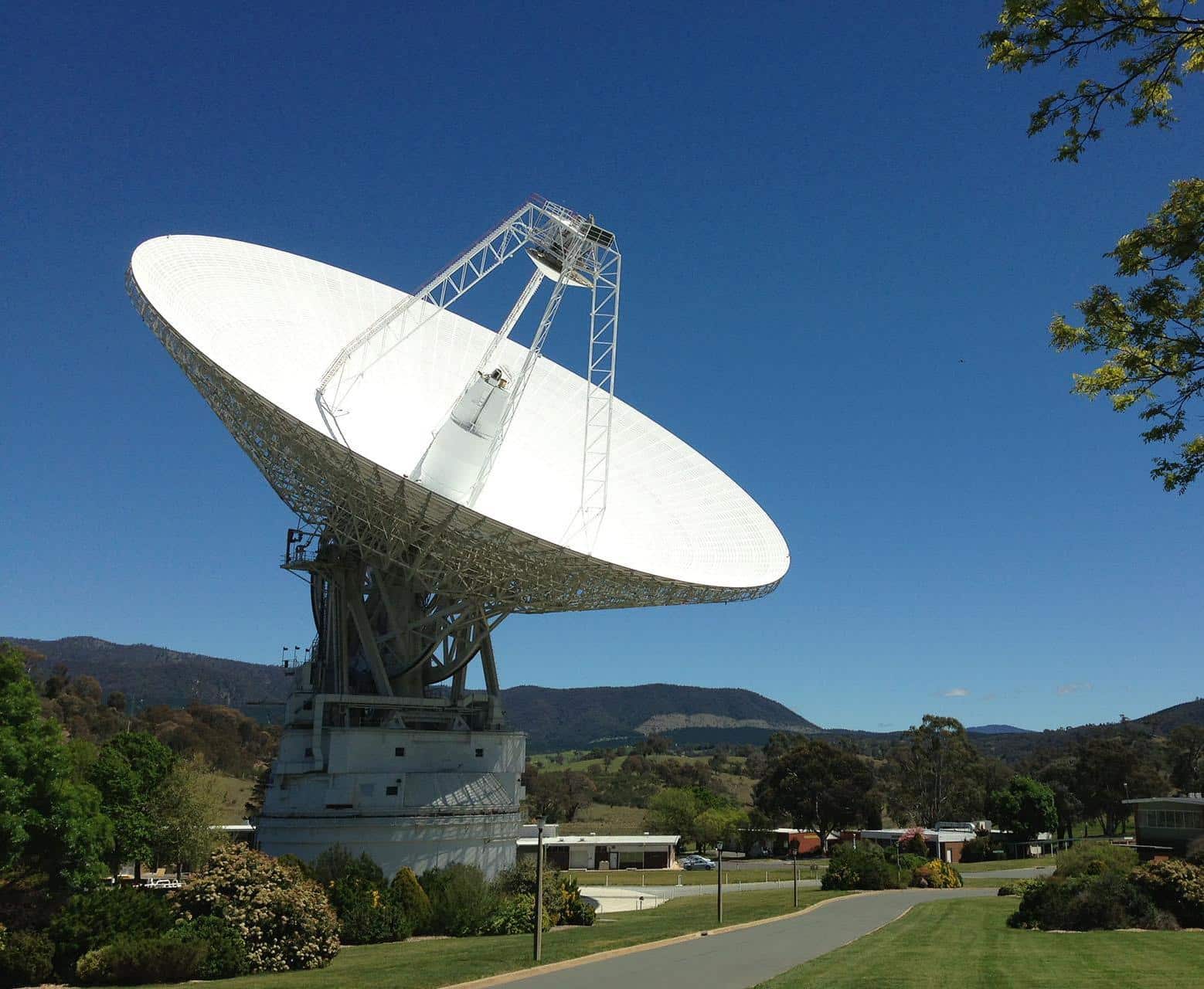
Inaugurated in 1973, NASA’s DSS-43 antenna is located 35 km from the city of Canberra, Australia. It is part of the agency’s DSN network. With a diameter of 70 m, it is the largest steerable parabolic antenna in the Southern Hemisphere. It notably allows communication with the Voyager probes.
© NASA

1 LIGHT-DAY from Earth

A little over 49 years after its launch, Voyager 1 continues to send us data and even receives instructions from NASA’s JPL via the largest antennas in its Deep Space Network (DSN). Consider that the radio signalemitted with 24 watts of power by Voyager 1 is now only a tiny billionth of a billionth of a watt from Earth and therefore requires the most powerful antennas in the DSN.
Several times, ground teams have managed to resolve technical issues , some of which could have meant the end of the probe . These remote repairs are carried out while any radio signal sent to Voyager 1 takes almost a day to travel through the vacuum of space. And the response takes almost as long…
NASA has calculated that on November 18, 2026, Voyager 1 will cross the threshold of a light-day distance, or 25.9 billion kilometers from Earth . This means that any radio signal will take one day to reach it, and then progressively more and more additional minutes. Voyager 1 was the first probe to reach such a distance. It is the most distant human-made object from Earth . Voyager 2 will not equal this record until November 2035.

TARGET 2030

Still facing dwindling electrical power, Voyager 1 received the order in April 2026 to shut down one of its three remaining active scientific instruments . This measure, along with other adjustments to the still-powered instruments, means the robotic explorer should continue operating until at least 2030. Where
is Voyager 1 headed? Its route leads to the star Gliese 445 (in the constellation Ursa Minor), 17 light-years away. Traveling at 61,000 km/h, it will pass within 1.7 light-years of Gliese 445   in 40,000 years…

AN AMBASSADOR FOR HUMANITY

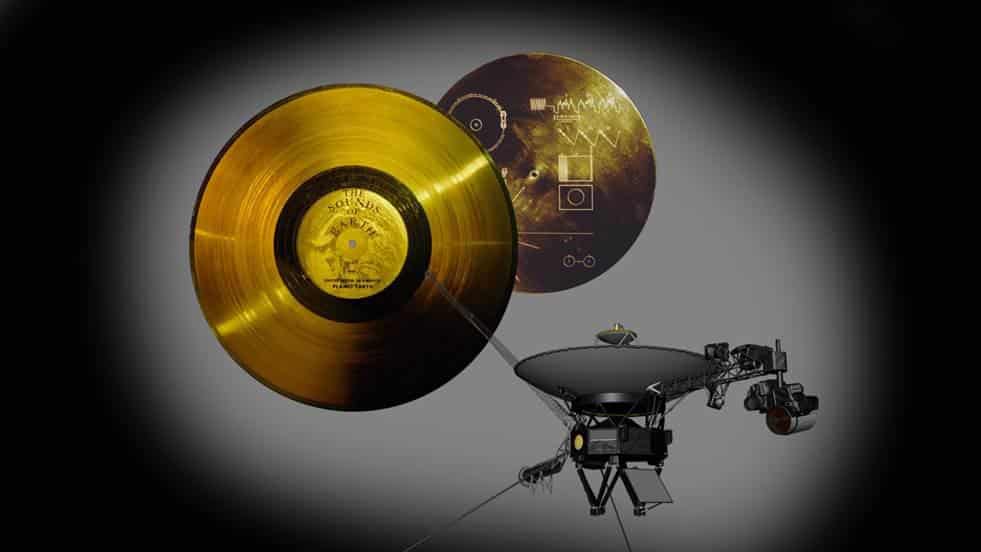
Finally, let’s not forget that Voyager 1 (like Voyager 2) carries a very special disc that makes it a robotic ambassador for humanity . Both probes are equipped with a disc called the Golden Record , which contains sound recordings and images. It includes music (classical and more modern), greetings in 55 languages, and about a hundred images of our civilization and nature. This selection was designed to represent humanity and its planet to a hypothetical advanced extraterrestrial civilization that might intercept one of the two probes. On one side of the disc, instructions for reading it are engraved in diagram form. A message in a bottle, cosmic version.

Voyager 1 (like Voyager 2) houses the Golden Record, a disc containing sounds and images representative of our planet and our civilization.
© NASA

Related articles