• Astronomy

The sky in July 2025

Published on 07 July 2025

Even though they're short, summer nights are still rich in celestial spectacles. In July, the Moon will help you spot planets and stars. Also enjoy meteor showers and the Milky Way.

The sky in July 2025

With the summer solstice in the northern hemisphere having passed, the nights are gaining extra minutes while remaining short . Remember that on July 15, in Toulouse, you have to wait until 11:45 p.m. for astronomical twilight, the moment when the Sun is at least 18° below the horizon, signaling the beginning of a dark night (which the Moon can, however, “disturb” with its brightness). July, however, brings some beautiful observations . Here is the program.

Reminder: Unless otherwise stated, times are those of legal time in metropolitan France . The maps are calculated for Toulouse, but remain in most cases applicable to the entire metropolitan territory.

This map shows the sky for Toulouse on July 15 at 11:45 p.m. (legal time, i.e., the time on your watch).
It is valid for most of July across metropolitan France, except for the position of the Moon (which is not yet up at that time).

© Cité de l’espace/Stellarium

The Moon and Spica

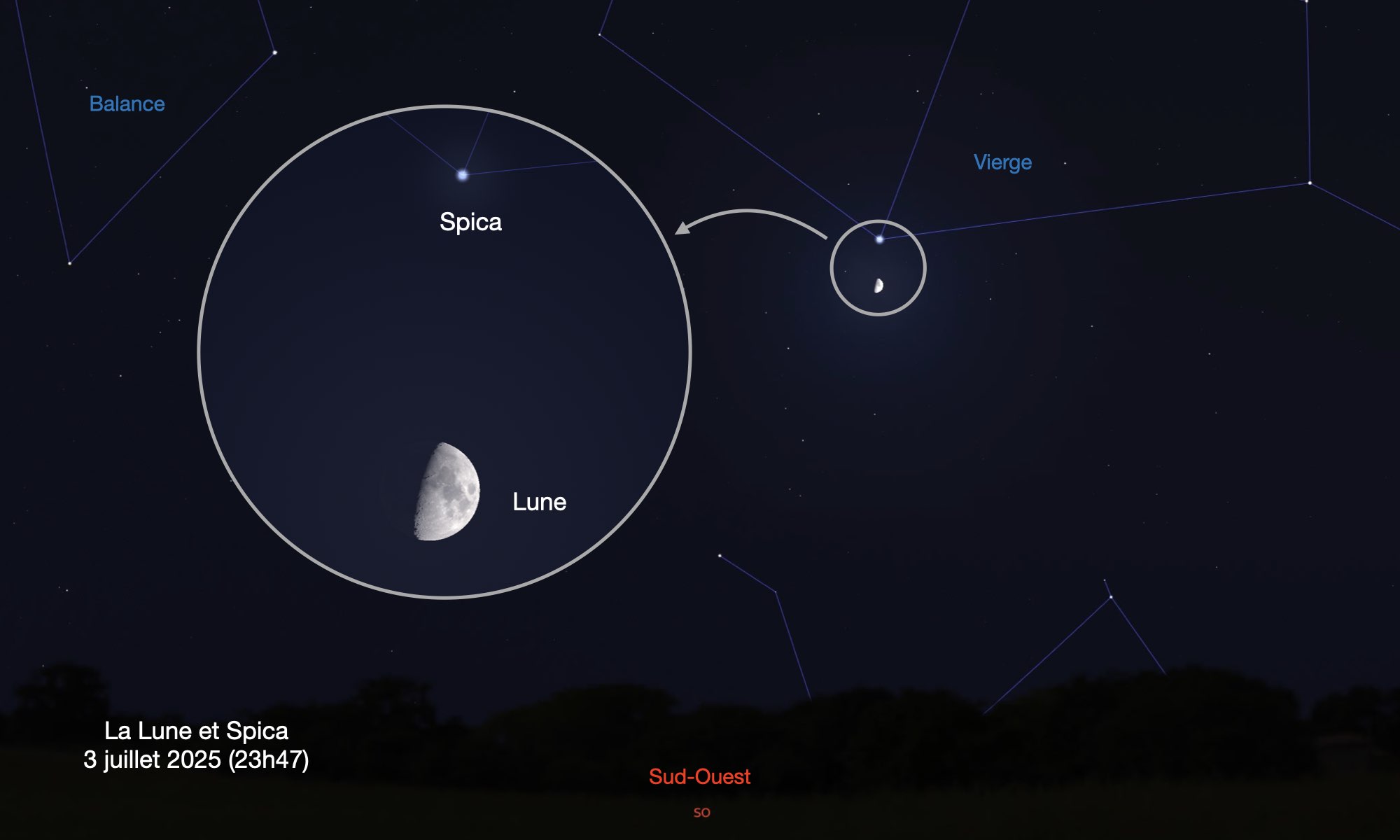
On July 3rd , easily find the Ear of Virgo thanks to our natural satellite. The Moon will indeed be about 1° from the star Spica , also known as Alpha Virginis, Alpha indicating that it is the brightest star (magnitude 0.98) in the constellation concerned, Virgo. In Latin, Spica is the ear (of wheat), the one held by Virgo in representations of the sky inherited from ancient Greece.
The gap between the Moon and Spica will be the smallest at 11:47 p.m. Our celestial neighbor will then be 17° above the southwest horizon. The rapprochement can be observed earlier for a higher Moon-Spica duo, but the sky will be all the clearer the earlier you look.

Also note that on July 3, the Earth will be at its farthest point in its orbit from the Sun in 2025, at 152 million kilometers . It was at its closest on January 4 at 147 million kilometers. This shows that the seasons are indeed a result of the tilt of our planet’s rotational axis and not of this slight variation in distance.

On July 3rd, in the southwest at 11:47 p.m., locate Spica, the brightest star in the constellation Virgo, thanks to the Moon.
© Cité de l’espace/Stellarium

The Moon and Antares

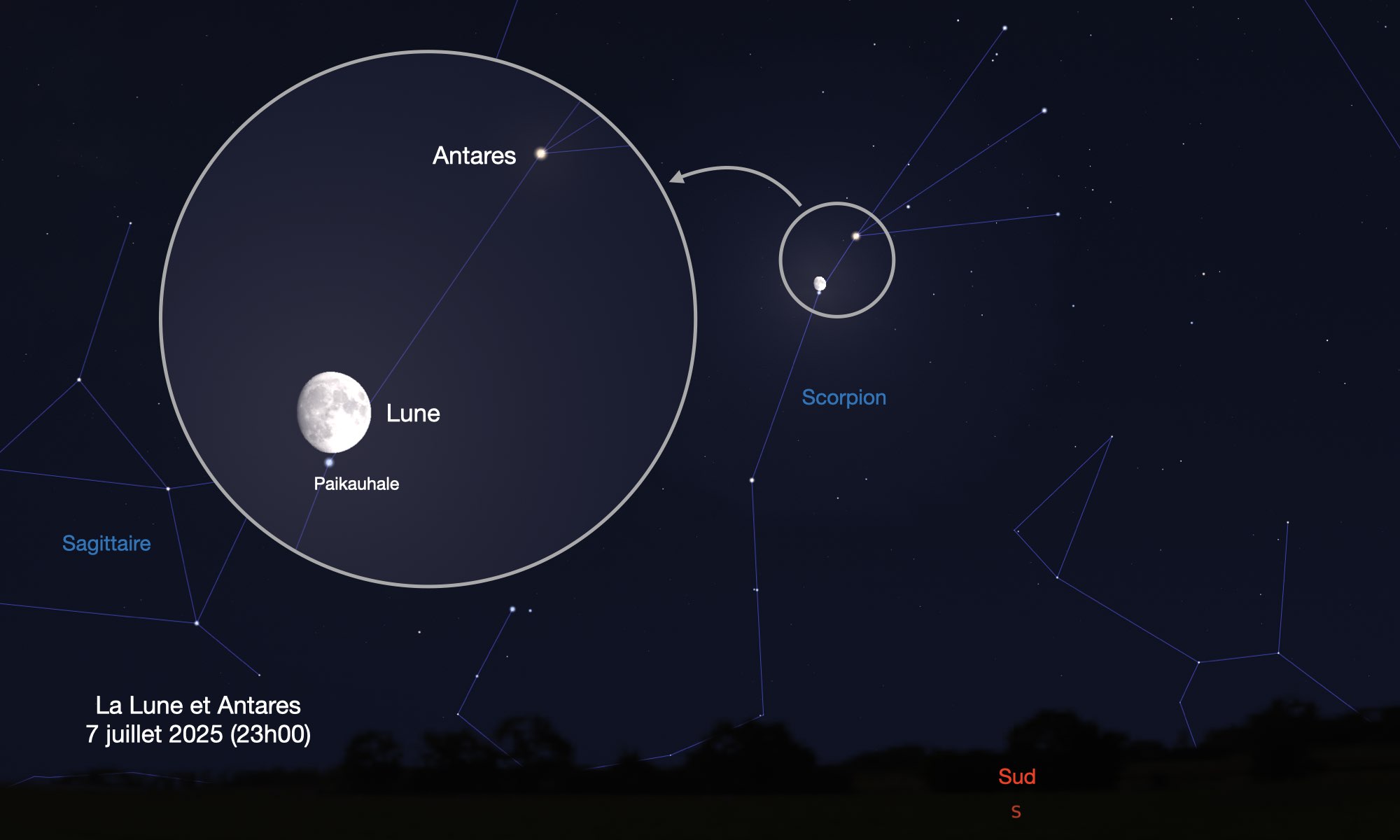
Four days later, our natural satellite helps us spot another star. On July 7, the Moon will be close (about 2°) to Antares . This is also the brightest star in its constellation, Scorpius, which is why it is called Alpha Scorpii. The duo will be 18° above the southern horizon.

Antares’ magnitude 1 gives it a brightness comparable to Spica, but with a distinct red glow. At 550 light-years away, Antares is a red supergiant much larger than our Sun, as it would encompass Mars!

Much closer to the Moon, the magnitude 2.82 star Paikaulahe (also known as Tau Scorpii) will be less obvious to spot, drowned in the strong glare of a Moon that is 89% illuminated.

On July 7, in the South, the Moon will help you find Antares, whose red glow will be evident.
© Cité de l’espace/Stellarium

The very modest Pegasids and Piscis Austrinids

The meteor showers are quite regular, in fact there are several listed each month. Not all of them are as “rich” as the classic and well-known Perseids of August, however. As for the discreet, even very discreet meteor showers (because of course they are not shooting stars), let us mention in July those of the Pegasids and Piscis Austrinids.
The first ( Pegasids ) whose radiant is in the constellation of Pegasus displays a very low ZHR (Zenithal Hourly Rate) of 0 to 3 (i.e. 0 to 3 meteors per hour at the zenith under a perfect sky). The peak is expected around the night of July 10 and it will be strongly hampered by the full Moon.
The second of the discreet showers is Piscis Austrinids with a radiant in Pisces Austris. The peak is expected around the night of July 28 . The zenith hourly rate of 5 is a little more encouraging (but nothing extraordinary), and the Moon won’t interfere this time.

We insist, these are extremely weak meteor showers.

The radiants of the Pegasids (peak around July 10) and the Piscis Austrinids (peak around July 28/29). Very discreet meteor showers.
© Cité de l’espace/Stellarium

The Moon and Saturn at dawn

And Neptune as a bonus

Like last June 19th , our celestial neighbor helps us find the ringed giant with Neptune as a bonus (much more difficult).
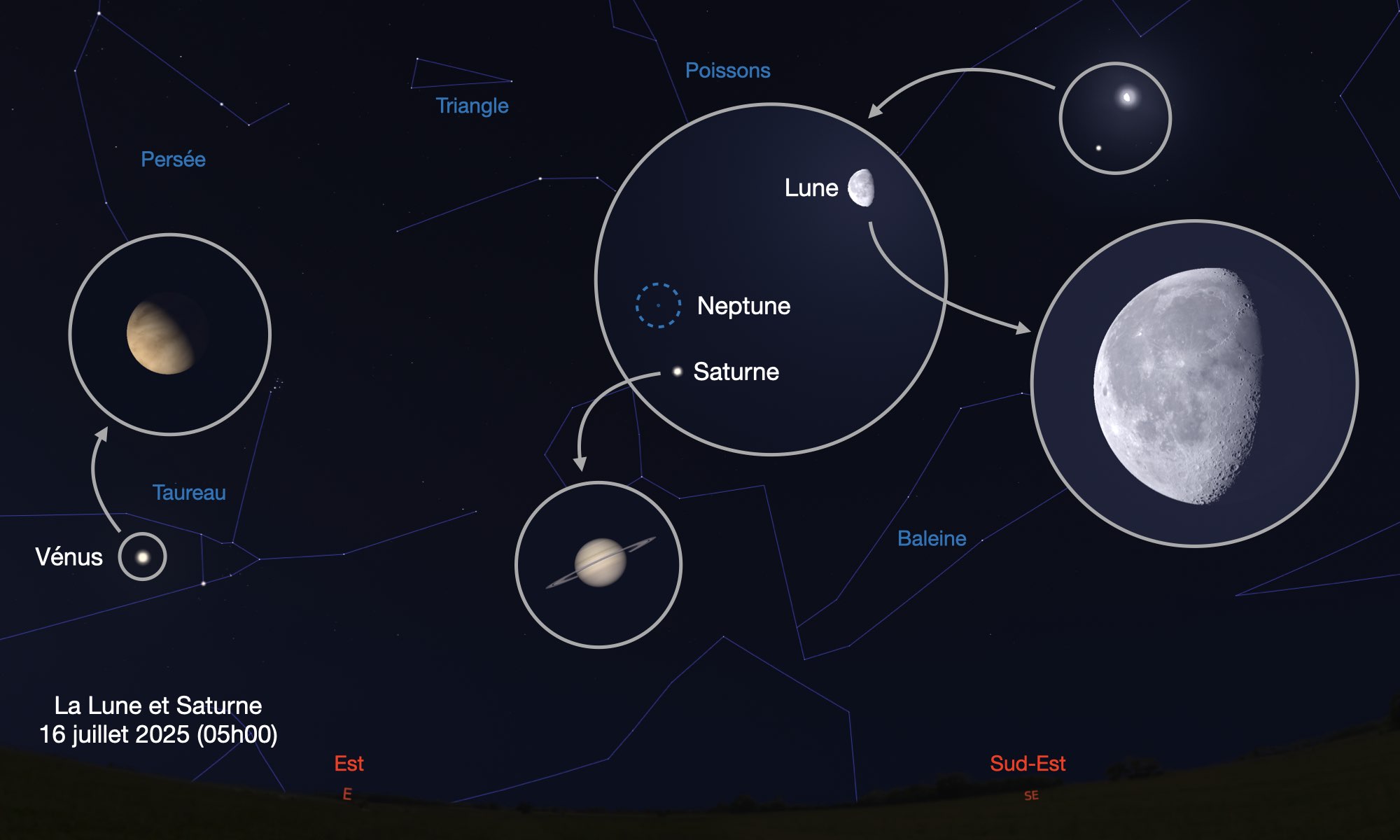
On July 16th, about 1h30 before sunrise (for Toulouse), look to the Southeast where a Moon will be enthroned at 43° altitude. Not far from there, to the lower left, the yellowish glow of Saturn will be easily distinguishable in this area . Out of curiosity, know that Neptune will be there, but you will need good binoculars or a telescope to capture its presence.

Much further to the left, to the east, Venus will impose its brightness of magnitude -3 within the constellation of Taurus.

We can have fun with the distances in the Solar System. The Moon will be almost 370,000 km away from us, Saturn 1.36 billion kilometers, Neptune 4.4 billion kilometers, and Venus “only” 157 million kilometers away…

On July 16, before sunrise, the Moon serves as your reference point for Saturn.
© Cité de l’espace/Stellarium

The Pleiades and the Moon

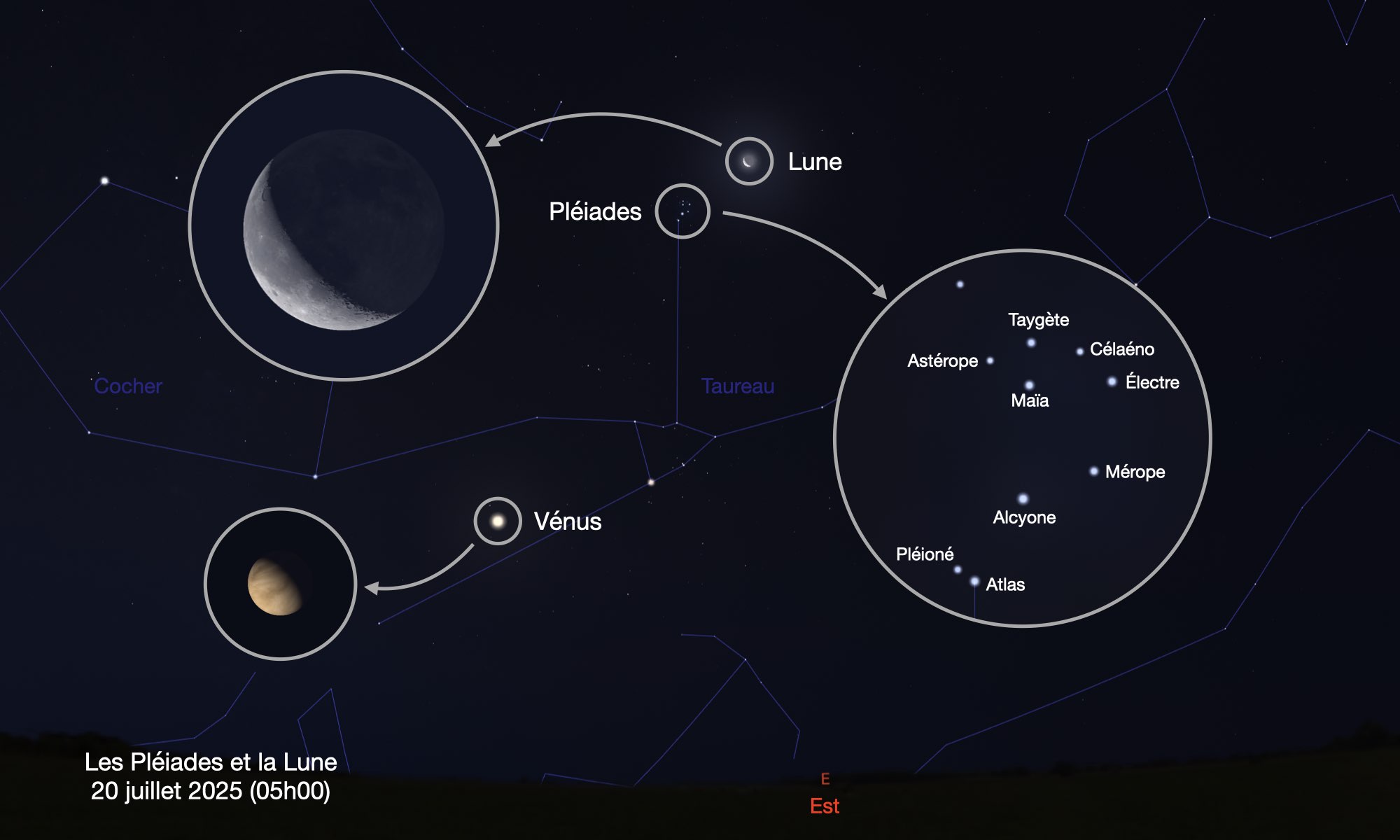
The Moon is our guide to the celestial vault this month, and on July 20th at dawn, we head to the Pleiades . This group of stars immortalizes in the constellation of Taurus the famous seven sisters of Greek mythology  : Alcyone, Asterope, Maia, Taygete, Celaeno, Merope, and Electra. Their father and mother seem to watch over them nearby thanks to two stars named Atlas and Pleione.
We now know that this is an open cluster of 3,000 young stars (only about ten are visible to the naked eye under good conditions) located about 440 light-years away from us . The delicate nebulae that surround them were thought to be remnants of their formation mechanism, but it is now thought that we are observing an interstellar cloud that they pass through as they disperse.

The Pleiades already offer a beautiful object to scrutinize with the naked eye , especially since it resembles a miniature Big or Little Dipper (the size in the sky is equivalent to 2 times the full Moon). Under a good night sky, we can easily see 5 of them. Capturing the 7 or 9 main ones (identified in the diagram below) requires skies clear of any light pollution and/or the use of binoculars.

On July 20, about 1.5 hours before sunrise (for Toulouse), a crescent moon in the east about 30 degrees above the ground indicates the Pleiades. Lower on the horizon, note the beautiful brightness of Venus.
© Cité de l’espace/Stellarium

The Moon and Venus

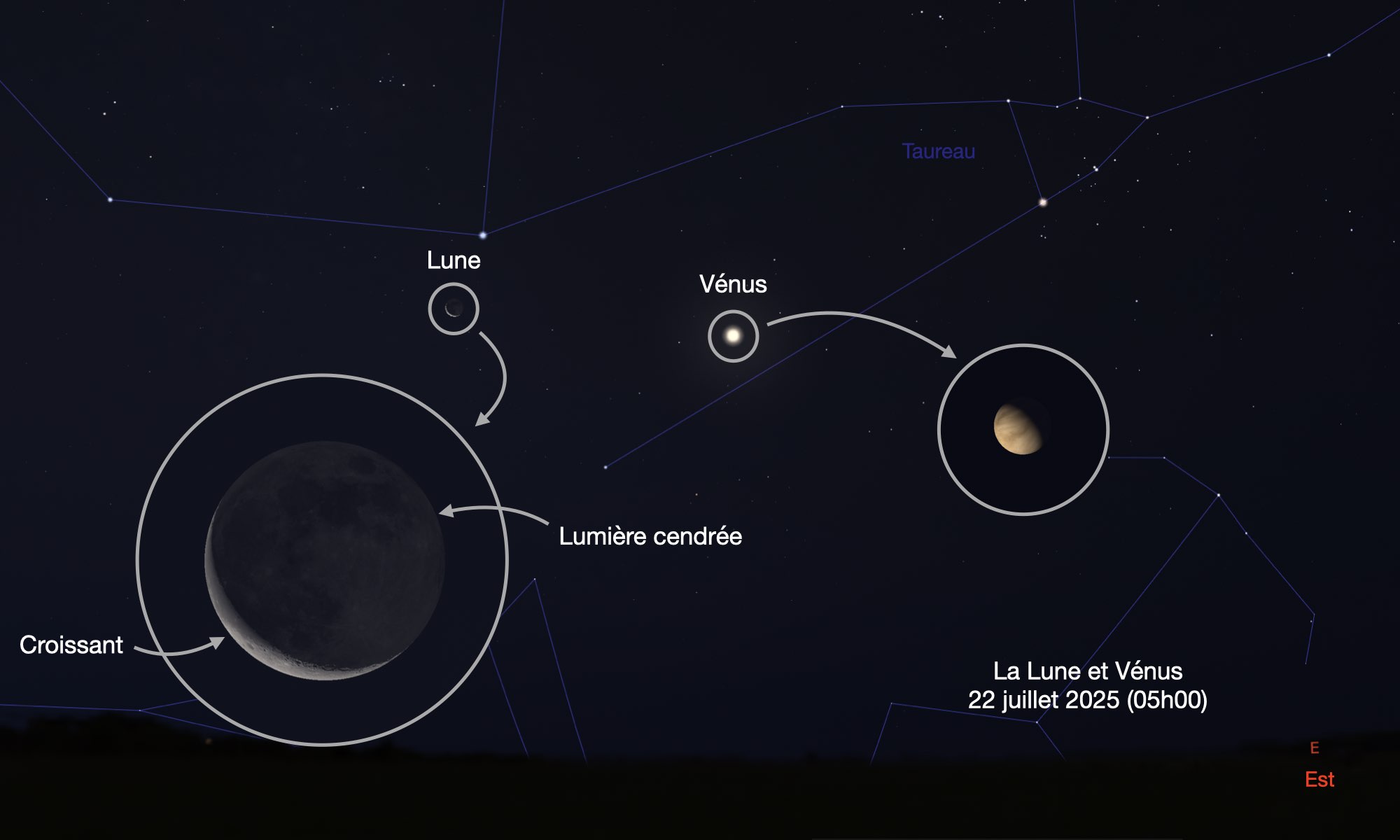
On July 22nd at dawn, the Moon and Venus offer us a fairly classic duo . This observation will be a challenge , however, because the Moon will be only 13° above the horizon (to the left of the East). You will need a landscape clear of any obstacles. Our natural satellite will be in the form of a thin crescent and the ashen light should be clearly visible (this is the light of the Sun reflected by the Earth which weakly illuminates the part of the Moon in the night).
If you wait until after 5 a.m., the Moon/Venus duo will certainly be higher in the sky, but watch out for the Sun which rises* in the same corner around 6:30 a.m. (for Toulouse).

(*) We remind you that the Sun should not be observed without adequate protection.

At dawn on July 22, Venus accompanies a thin crescent Moon.
© Cité de l’espace/Stellarium

The Moon and Jupiter

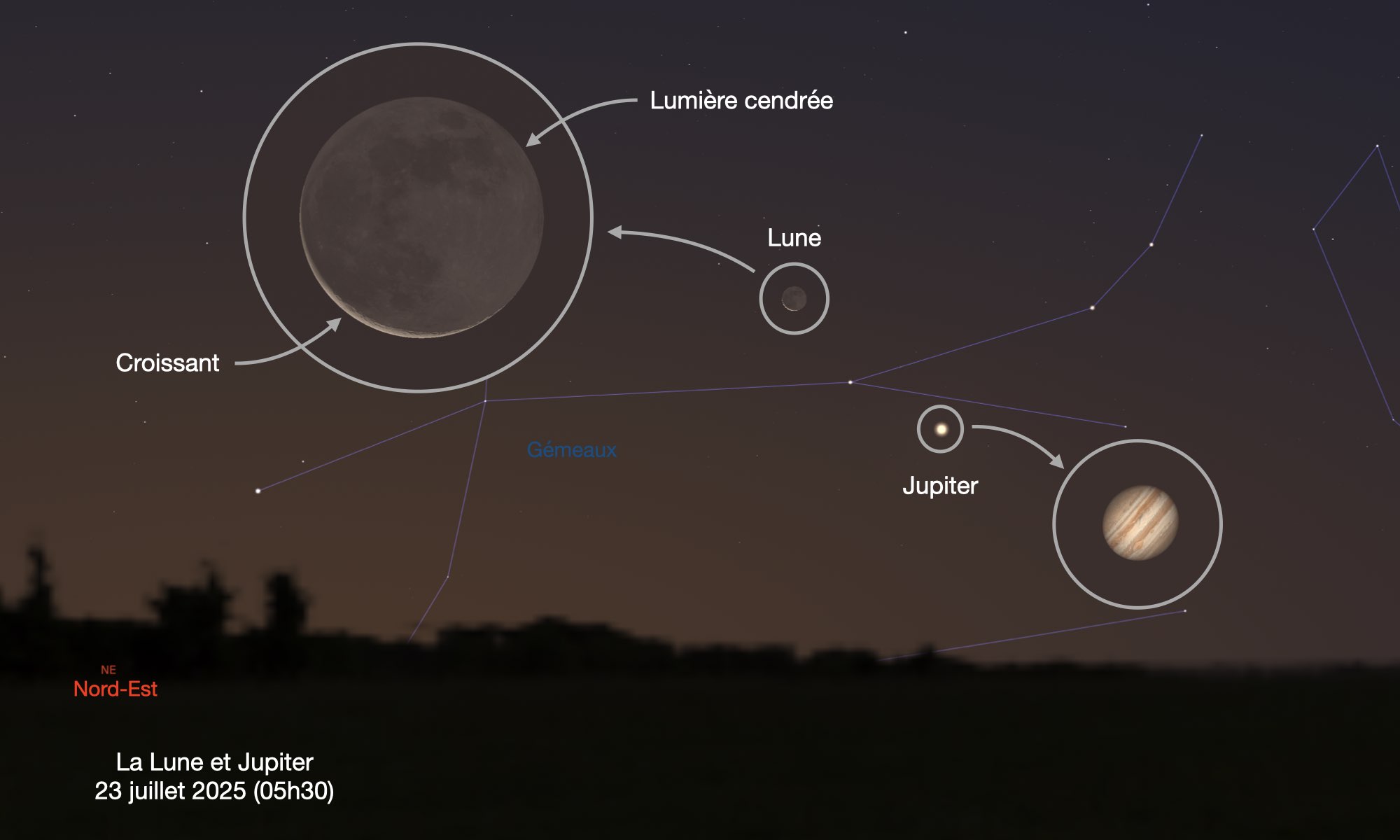
Ready for another morning challenge near the horizon? Between the East and Northeast, on July 23 at dawn, we find the Moon with an even thinner crescent (illumination at only 3.4%) and still its ashen glow. The planet accompanying it this time is the gas giant Jupiter , the largest world in the Solar System.

It will be even less easy than the 22nd, because the Moon will only be 8° high at 5:30 a.m. (about an hour before sunrise) and for Jupiter, only 5°!

In short, an observation at the horizon which will not be easy.

Beware of the Sun rising* in the same area around 6:30 a.m. (for Toulouse).
(*) We remind you that you should not observe the Sun without adequate protection.

On July 23 at dawn, very low on the horizon, try to capture a very thin crescent Moon accompanied by Jupiter.

© Cité de l’espace/Stellarium

Admire our galaxy, the Milky Way

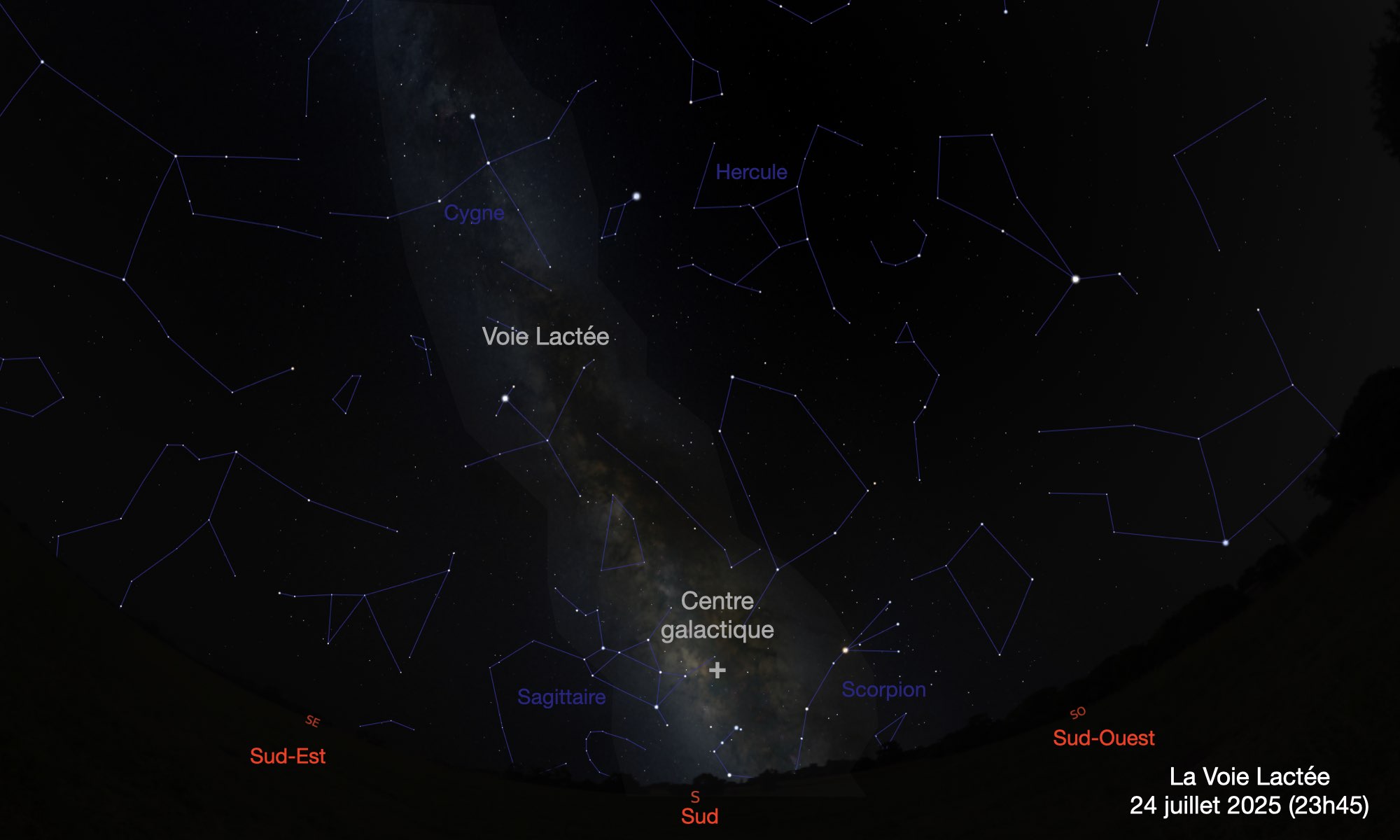
As explained at the beginning of the article, in July, the dark night (the Sun is lower than 18° below the horizon) begins late. And for July 2025, the Moon will come to hinder with its brightness the observation of the Milky Way, our galaxy seen edge-on . In addition, this wonder of the night sky is almost impossible to see in the city due to light pollution. But the New Moon of July 24 will be our ally! A few days before and a few days after, our natural satellite will therefore not come to add its brightness, offering us beautiful nights ideal for contemplating the Milky Way .
We logically present here the example of July 24.

First of all, it is essential to move away from urban centers so as not to be bothered by light pollution . If you are on a terrace, don’t forget to turn off the outdoor lights. Don’t consult your smartphone either, its glossy screen prevents your vision from adapting to the night (allow about 10 to 15 minutes). You will then notice to the South a wider grayish band close to the horizon and which rises in the firmament: you are then looking at the Milky Way, our own galaxy seen edge-on and from the inside. Binoculars will reveal that this milky band is in fact teeming with stars, those of our galaxy. There are 200 to 400 billion of them, of which we only perceive a tiny part… The Milky Way, a barred spiral galaxy, has a diameter estimated at 120,000 light years . The opportunity to think back to a famous photo from Voyager 1 and the text ” a pale blue point “.

Above the southern horizon, the constellation of Sagittarius, with its shape reminiscent for some of a teapot, will be your guide to imagining where the galactic center is located. By looking in this direction, your eyes are therefore turned towards the center of our galaxy , its bulge and nucleus at the heart of which sits the supermassive black hole Sagitarius A* of 4.3 million solar masses.
© Cité de l’espace/Stellarium

The Moon and Mars

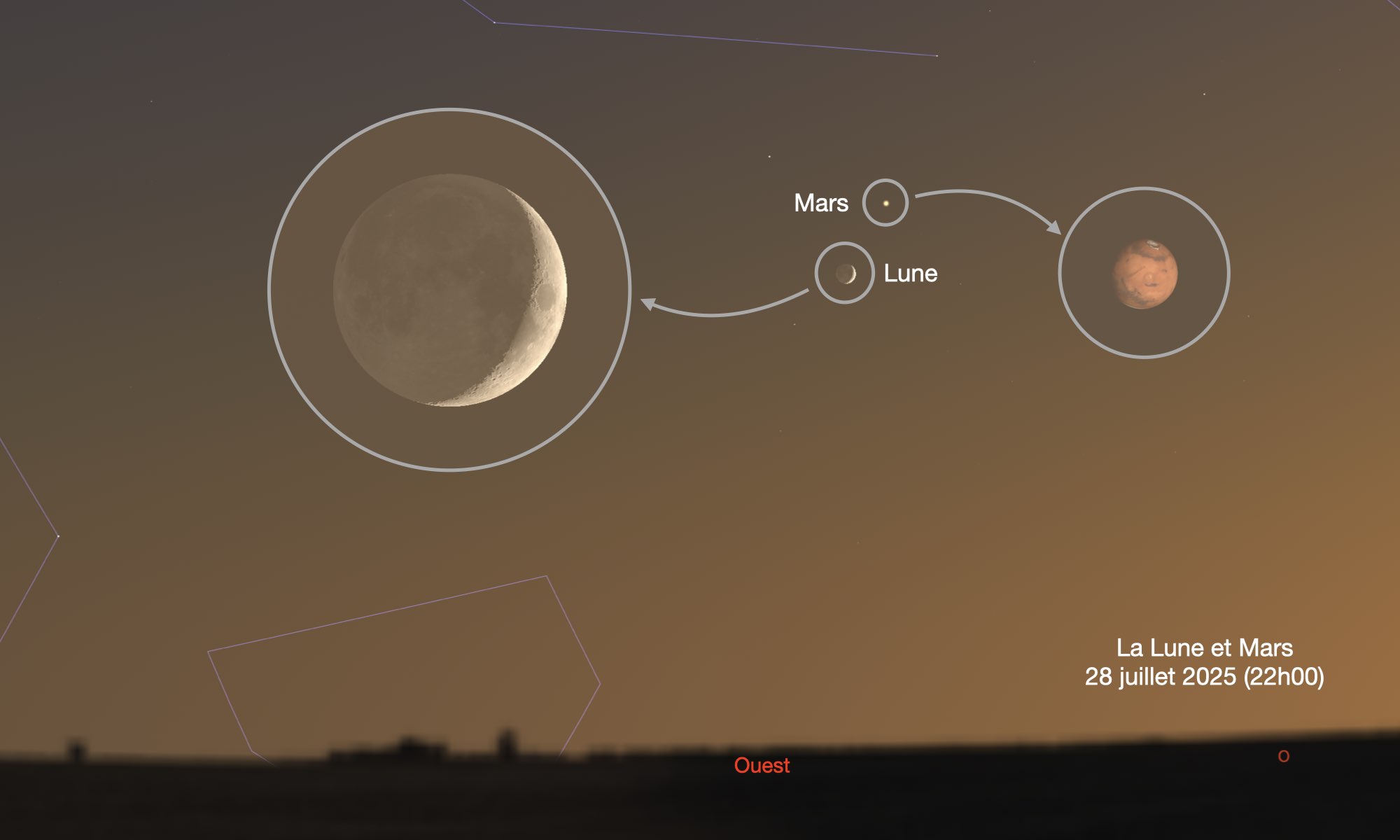
The New Moon has passed and the crescent Moon is getting bigger and bigger. On July 28 , it will be a “young” crescent with our celestial neighbor illuminated at 17%. Orient yourself towards the West, 30 minutes after sunset (you avoid any risk to your eyes) to capture the Moon at 12° height which accompanies the orange glow of Mars . The glow of the setting sun could well hinder the observation of the red planet. A pair of binoculars could help and that is why we will only do it once the Sun has actually set ! We remind you that we should not observe the Sun without adequate protection.
The longer you wait, the darker the sky will become, but the Moon/Mars duo will plunge towards the horizon when it was already not very high. In short, another observation at the level of the horizon.

On July 28, try to see the Moon and Mars after sunset. A perfectly clear horizon is a must…

© Cité de l’espace/Stellarium

Watch for the Alpha Capricornids and Delta Aquarids South

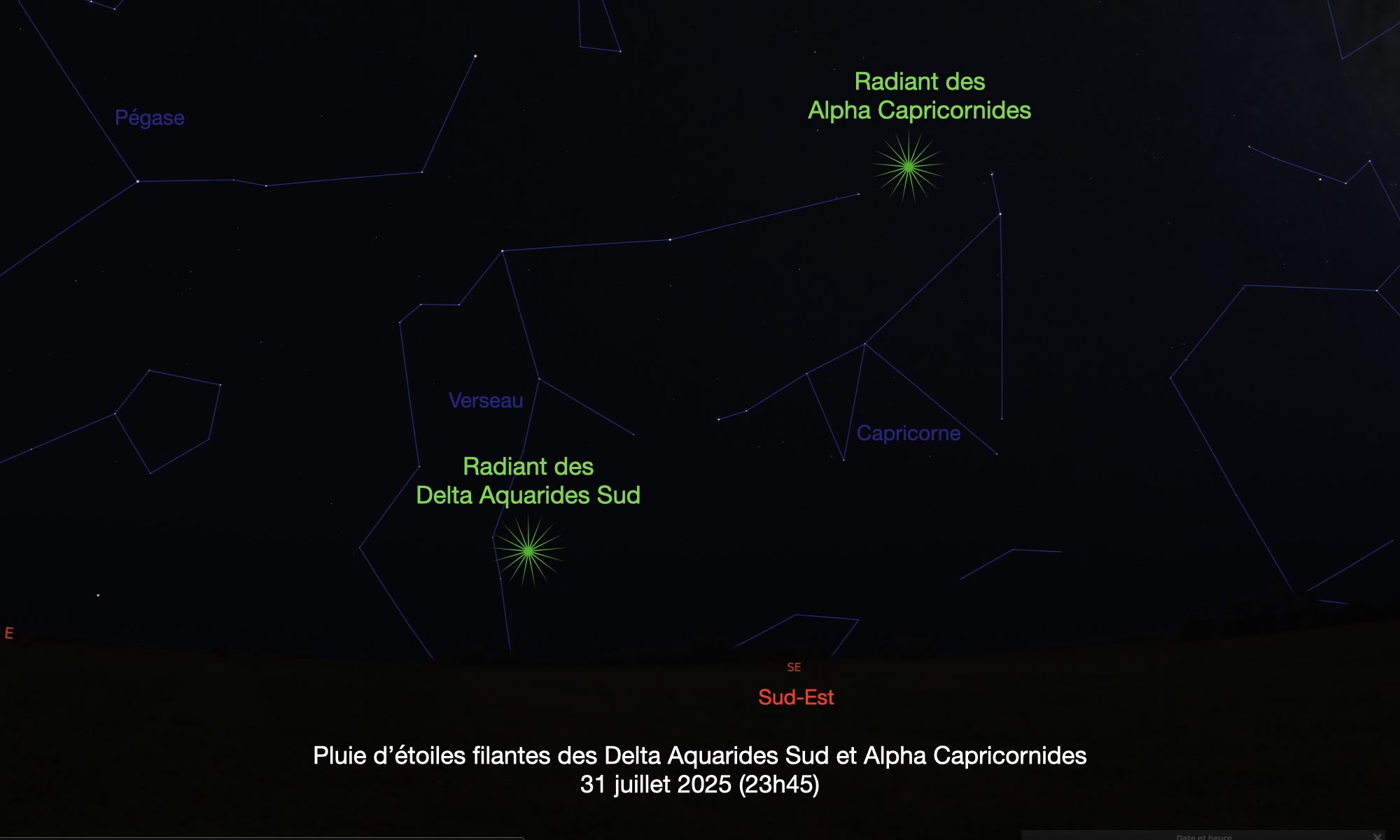
Don’t expect the equivalent of the August Perseids at the end of July with the Alpha Capricornids and Southern Delta Aquarids. These two meteor showers, however, can be more interesting than the very modest Pegasids and Piscis Austrinids mentioned above.

The Alpha Capricornids (because the radiant is in Capricorn) are considered active from July 12 to August 12. The dust that enters our atmosphere and then streaks the sky comes from comet 169P/NEAT. The ZHR is estimated at 5 to 10, rather weak , but with a peak expected on July 31 , the crescent Moon will set early in the night and will not be a problem.

Active from July 12 to August 19 , the Southern Delta Aquarids also have an estimated peak on July 31. The ZHR is more interesting with 16 to 25 (so a maximum of 25 shooting stars per hour in perfect conditions).

Remember that the ideal instrument is nothing other than your eyes . Set yourself up far from any light pollution (including that of your smartphone) so that you can take in the sky with your eyes… and be patient . There’s no need to necessarily want to scrutinize where the radiant is. Finally, don’t forget that estimates of the date of a peak are not absolute.

At the end of July, take advantage of a Moon that won’t interfere much to see if the Alpha Capricornids or the Southern Delta Aquarids bring some shooting stars.
© Cité de l’espace/Stellarium

Related articles