



• Solar System

Europa Clipper: In search of a habitable ocean

Published on 11 October 2024

The American probe Europa Clipper is heading towards Europa, Jupiter's icy moon. The objective of this mission is to determine whether its ocean, beneath its ice crust, has the conditions to support life. Arrival scheduled for 2030.

Europa Clipper: In search of a habitable ocean

Is life a specificity of planet Earth? Has it developed, in other forms, elsewhere in the Solar System? These questions are the origin of the major planetary missions to Mars, Venus, and to the moons of the gas giants. The American mission Europa Clipper is part of this approach. The probe took off on October 14 at 6:06 p.m. and will focus particularly on Europa, one of Jupiter’s largest moons. Its journey will last nearly six years and allow it to perform 45 flybys of this moon. The objective is to determine whether Europa is or has been habitable. This NASA mission complements the European mission JUICE, which departed in April 2023 to fly over not only Europa, but also Callisto and especially Ganymede

Relive the launch of Europa Clipper

The SpaceX Falcon Heavy launcher left the launch pad on October 14, 2024, at 6:06 p.m.

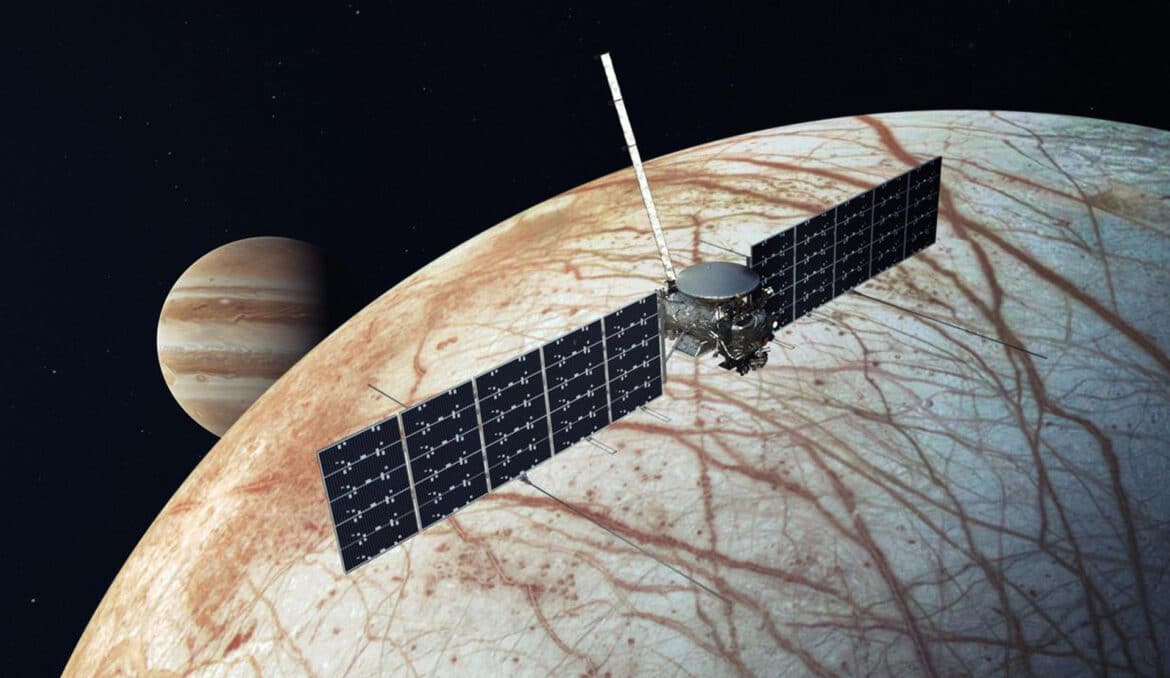
Europa Clipper has nine instruments: cameras, spectrometers, a radar, and a magnetometer. Its 3 m diameter antenna allows it to stay in contact with Earth.

© NASA

What are the objectives of the Europa Clipper mission?

Europa Clipper must determine whether Europa has the conditions necessary for the appearance of life

The objective is not to detect life itself, but to determine whether the ocean beneath Europa’s surface is habitable. The Europa Clipper probe will therefore study the icy moon in detail. Initially, it must confirm the presence of water under the ice crust and characterize this ocean. Indeed, in the early 2000s, the Galileo mission detected a magnetic field specific to Europa. One possible interpretation is that there is a saltwater ocean under the ice surface. Europa Clipper will therefore have to confirm this hypothesis and collect characteristics: its depth, its salinity, and its composition. It will also study the exchange processes between the ocean, the ice pack, and the surface.

Analysis of Europa’s surface

Europa Clipper will also analyze the chemical composition of the surface, the ice pack, and Europa’s exosphere. It will thus be able to determine whether the elements necessary for life are present. The analysis of geysers that could eject water from the underground ocean into space will provide valuable information on the composition of the ocean. Finally, the probe will try to study the geology of Jupiter’s moon. The mission must map the surface of Europa in high resolution, identify the geological formations, and understand the geological processes that have shaped the moon.

Jupiter’s icy moon Europa, taken by the Juno probe.

© NASA

coiffe_europa_clipper

The probe and its folded solar panels were placed in the fairing of SpaceX’s Falcon Heavy, which is to carry out its launch.

© NASA

How will the Europa Clipper mission unfold?

The Europa Clipper mission will arrive in the Jovian system in 2030

The launch was scheduled for October 10, on a SpaceX Falcon Heavy. However, Hurricane Milton, which crossed Florida, delayed this launch. The launch finally took place on October 14 at 6:06 p.m. Once in transit to the Jovian system, the journey is expected to last five and a half years. During this phase, Europa Clipper will perform flybys of Mars and Earth to benefit from gravitational assistance and thus increase its speed. It is in April 2030 that Europa Clipper should arrive at its destination. It will then use its main propulsion to slow down and place itself in orbit around the giant planet, Jupiter. It is only a little over a year later that the scientific work should be able to start. Between May 2031 and 2034, Europa Clipper will carry out a series of 45 close flybys of Europa at altitudes varying from 25 to 2,700 kilometers. These flybys will allow the space probe to collect detailed data on the moon using its scientific instruments. At the end of the mission, it is planned to precipitate Europa Clipper on the surface of Ganymede

Europa Clipper will enter an elliptical orbit around Jupiter to complete its 45 flybys of the moon Europa.

© NASA

europa_clipper_airbus

The Europa Clipper’s 102 m² of solar panels were designed by Airbus in the Netherlands.

© NASA

102 m² of solar panels

At this distance from the Sun, the surface area of solar panels is colossal to hope to power the probe. While JUICE already carries 85 m² of solar panels, Europa Clipper is equipped with photovoltaic cells with a total surface area of 102m². Last year, the Psyche probe, which set off to explore the asteroid of the same name, was equipped with only 75 m² of solar panels. Designed by Airbus in the Netherlands, they will provide it with 700 Watts at the end of the mission at the level of Jupiter, i.e. a power 25 times lower than that received at the level of the Earth. This energy will be stored in batteries. Europa Clipper will thus be able to power its nine scientific instruments, including cameras, spectrometers, a radar, and a magnetometer. This energy will also allow it to communicate with Earth thanks to its 3m diameter antenna. Finally, it will also allow it to maintain its temperature and perform maneuvers.

What is the difference with the European mission JUICE?

The two missions are complementary, JUICE will also fly over Europa, but will study Ganymede more precisely

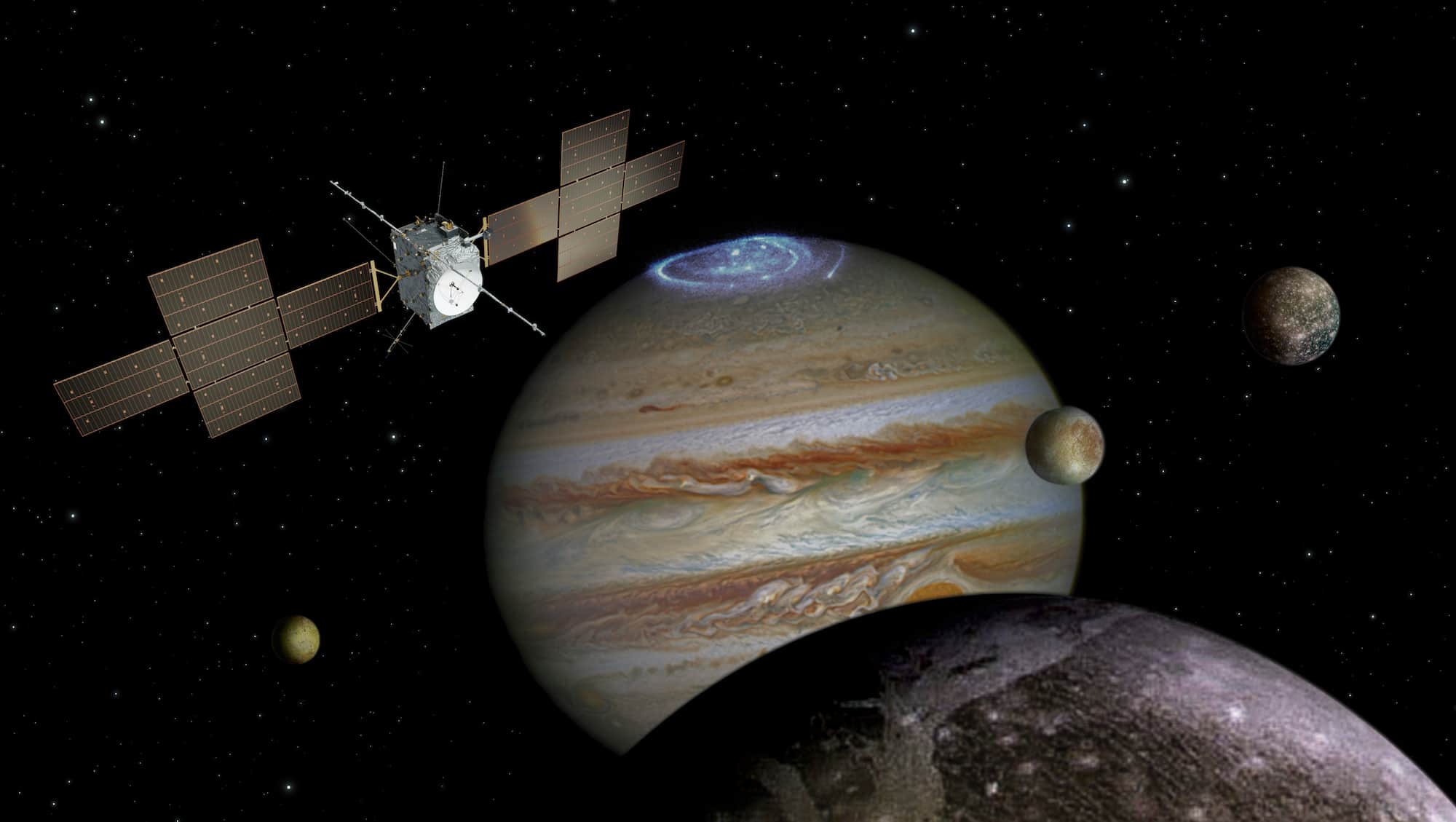
JUICE (Jupiter Icy Moons Explorer) is a mission of the European Space Agency (ESA) launched in April 2023. It is one of the last flights of the Ariane 5 launcher. JUICE will also explore the Jovian system, focusing on three of Jupiter’s moons, Europa, Callisto, and especially Ganymede. But although it left a year and a half earlier, JUICE will not arrive until a year and a half later than the American probe. Indeed, Europa Clipper can count on the power of the SpaceX heavy launcher, Falcon Heavy. JUICE will not arrive in the Jovian system until July 2031 and above Europa in July 2032. It will fly over this moon twice before carrying out five flybys of Callisto, mainly to use its gravitational assistance to slow down. Finally, in November 2033, it is planned that it will place itself in orbit around Ganymede, which should also house an ocean under its ice crust.

JUICE will arrive in the Jovian system in 2032 and begin its mission in November 2033.

© ESA

header plaque europa clipper

A tantalum plate and 2.6 million names

Europa Clipper carries a commemorative tantalum plate on which the word "water" is engraved in one hundred different languages, as well as a poem by the American Ada Limón entitled "In Praise of Mystery: A Poem for Europa". In addition, a campaign had been launched to send its name into space. A microcircuit containing the names of 2.6 million people who participated in the "Message in a Bottle" campaign has been affixed to the plate.

Related articles